The bus was crowded that day.
Passengers stood shoulder to shoulder, holding onto the rails as the vehicle moved through the busy street. Then an elderly woman stepped onto the bus. She looked tired, moving slowly as she reached for the handrail to keep her balance.
There were no empty seats.
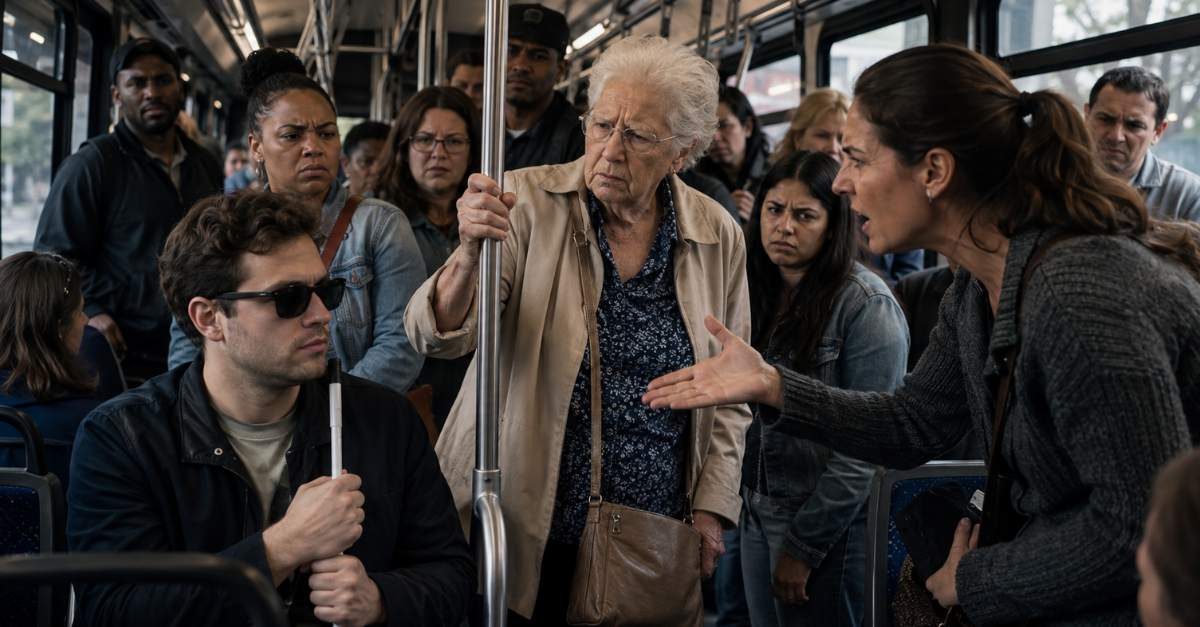
Near her, a young man wearing dark sunglasses remained seated.
At first, a few passengers simply looked at him.
Then the whispers began.
Some people stared at the elderly woman, then turned their eyes toward the young man. To them, the situation seemed obvious. A young man was sitting comfortably while an elderly woman was forced to stand.
Before long, one woman spoke up.
“You’re young. Why don’t you give her your seat?”
The man did not answer.
He sat quietly, both hands gripping a cane beside him.
But no one paid attention to the cane.
They only saw his age.
They only saw the seat.
And they quickly decided what kind of person he must be.
More passengers began to criticize him.
Some shook their heads.
Some whispered that young people no longer had manners.
Others spoke loudly enough for him to hear, accusing him of being selfish and disrespectful.
Still, the man remained silent.
His face was calm, but his hands tightened slightly around the cane.
No one asked if he was okay.
No one asked if he needed the seat.
No one stopped to think that not every struggle is easy to see from the outside.
Finally, after being pressured again and again, the man slowly began to stand.
The bus grew quieter.
He reached out carefully, feeling for something to hold onto. His movements were slow and uncertain. The dark sunglasses were not just a fashion choice — they were covering eyes that could not see.
Then, as he stepped away from the seat, the truth became even clearer.
One of his legs was a prosthetic.
The young man everyone had just judged was not only visually impaired. He was also living with the loss of a leg.
The entire bus fell silent.
The people who had been criticizing him moments earlier lowered their eyes in shame. Their angry words suddenly had nowhere to go. The person they had accused of being careless had been struggling quietly the whole time.
And yet, despite everything, he had still tried to stand and give his seat to the elderly woman.
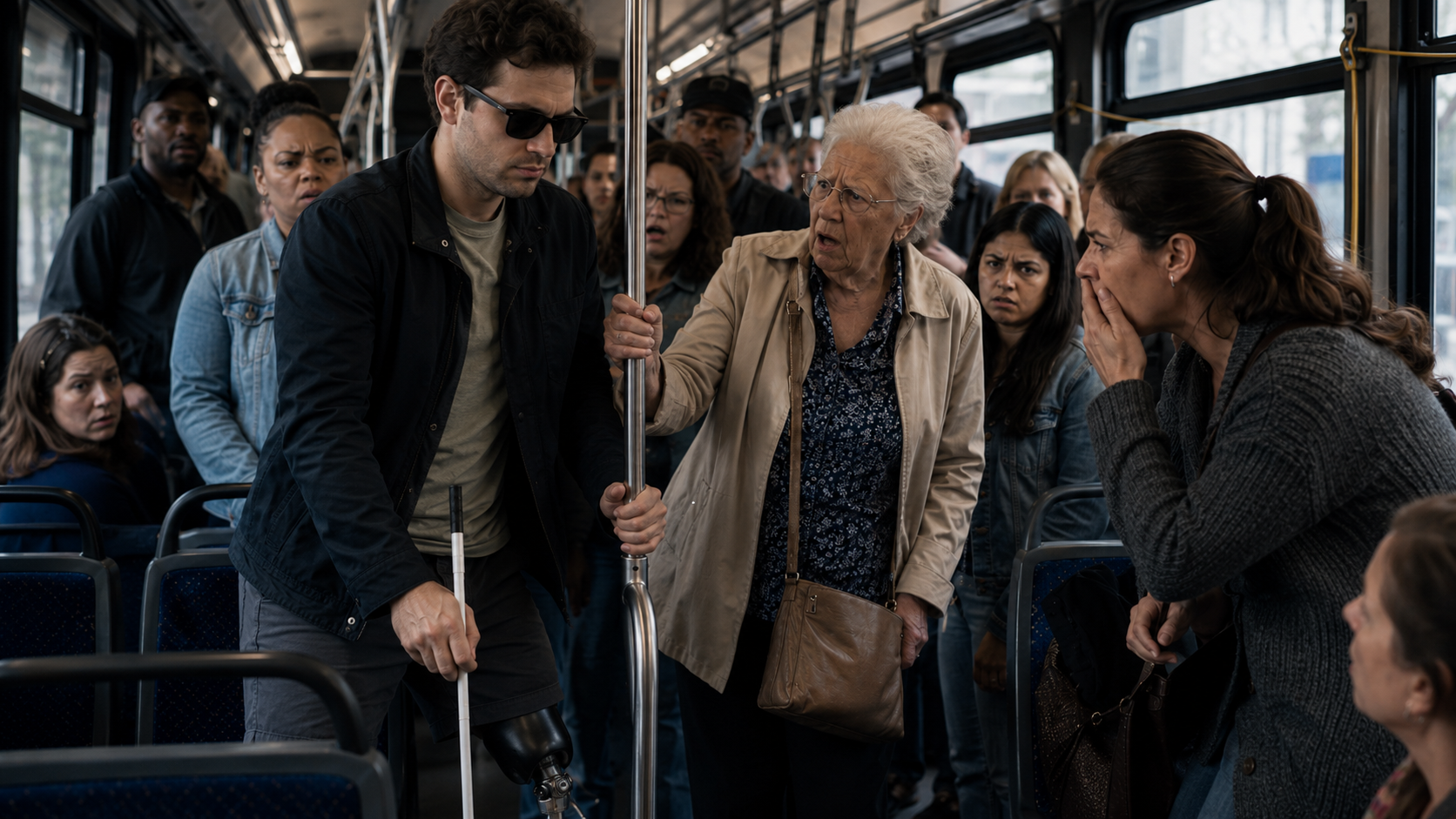
The elderly woman looked at him with sadness and understanding. She gently held his hand and gestured for him to sit back down. She did not want him to hurt himself just because others had judged too quickly.
Another passenger immediately stood up and offered his seat to her.
The young man slowly sat back down.
No one dared to say another word.
The silence on the bus carried a lesson heavier than any argument.
Not every disability is obvious.
Not every pain can be seen.
Not every person who stays seated is being selfish.
Sometimes, the person we are judging is already carrying a difficulty we know nothing about.
The passengers had looked only at the surface. They saw a young man and assumed he was strong. They saw sunglasses and thought nothing more. They saw someone sitting and decided he was wrong.
But they never saw the full story until it was too late.
That moment reminded everyone on the bus of something important: kindness should come before judgment.
It is easy to criticize when we only see one part of a situation.
It is easy to assume when we do not ask.
But real compassion means pausing before speaking, looking deeper before blaming, and understanding that many people suffer quietly without explaining themselves to the world.
The elderly woman got a seat.
The young man kept his dignity.
And the people on the bus were left with a lesson they would not forget.
Before judging someone, remember this:
Some battles are hidden.
Some pain is silent.
And sometimes, the person we are about to criticize is the one who needs kindness the most.
