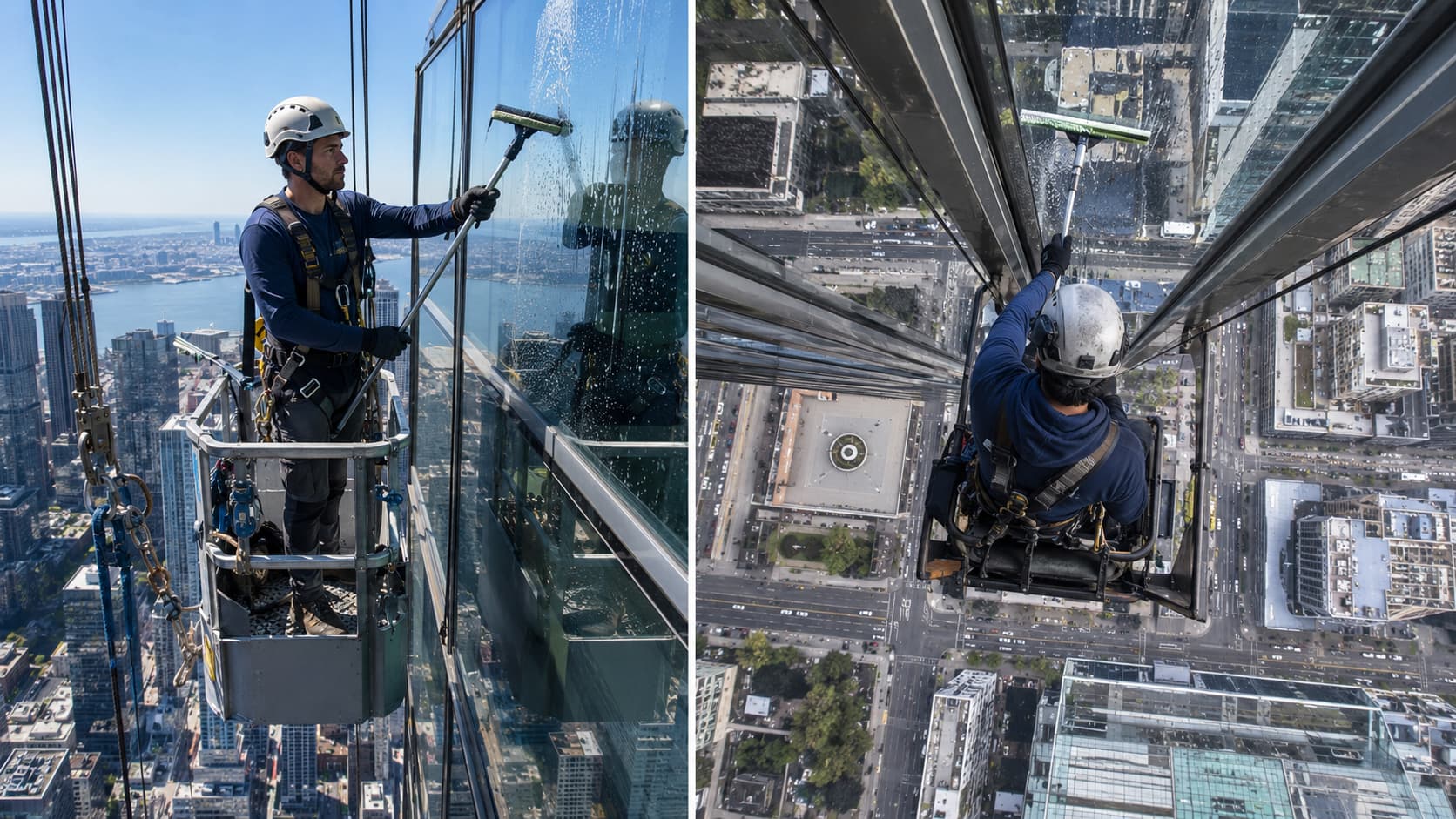
Most people look at a skyscraper from the street or through a window from the inside.
High-rise window cleaners spend their workday on the other side of that glass.
They may work dozens of stories above busy streets, standing on suspended platforms or using specialized access systems while cleaning windows that cannot be reached from inside the building.
From the ground, the job can look terrifying. Cars appear tiny, wind can move around the building, and the worker may spend hours with hundreds of feet of open space below.
So how does this job actually work in the United States? How much can a high-rise window cleaner earn? And what does someone need to do this work safely?
What Does a Skyscraper Window Cleaner Actually Do?
The job is about more than simply washing glass.
High-rise window cleaners need to reach exterior windows on office towers, apartment buildings, hotels, hospitals, and other tall structures.
One common system is a two-point suspended platform, often called a swing-stage scaffold. OSHA describes this type of platform as being suspended by ropes or cables and notes that it is commonly used by window washers on skyscrapers.
Some jobs may instead involve single-point suspended equipment, including the type commonly known as a boatswain’s chair. OSHA also identifies this system as one used for exterior skyscraper window cleaning.
Once positioned outside the building, the worker typically cleans one section at a time using tools such as squeegees, scrubbers, cleaning solution, buckets, and extension equipment.
But before any glass is cleaned, workers have to prepare and inspect the equipment that keeps them safely positioned outside the building.
How Much Do High-Rise Window Cleaners Make?
There is no single federal salary specifically for “skyscraper window cleaner.”
The Bureau of Labor Statistics groups window washing within broader building-cleaning occupations rather than tracking high-rise window cleaners as a separate occupation.
For context, BLS reported that janitors and building cleaners had a median wage of $17.27 per hour in May 2024. The highest-paid 10% in that broader occupational group earned more than $23.58 per hour.
High-rise window cleaning may pay differently because the work can involve specialized access systems, fall protection, experience at height, and other skills not required for routine indoor cleaning.
Current U.S. job listings provide a useful look at what employers are offering.
Indeed listings for high-rise window washing currently include positions around $19 per hour, while some experienced positions advertise approximately $22 to $27 per hour.
Other current postings in California show some experienced high-rise roles advertising approximately $28 to $33 per hour.
That means a worker earning:
- $20 per hour and working 40 hours per week would gross about $41,600 per year before taxes and other deductions;
- $25 per hour would equal about $52,000 per year;
- $30 per hour would equal about $62,400 per year.
Those are simple full-time calculations, not guaranteed salaries.
Actual annual income can change because of overtime, weather delays, seasonal workloads, location, employer, experience, and the number of hours available.
Does Working Higher Mean Getting Paid More?
Not automatically.
A cleaner working on a 50-story building does not necessarily receive dramatically more money simply because the building is taller.
Pay usually depends on a combination of factors such as:
- experience;
- employer;
- local labor market;
- specialized safety training;
- rope-access or suspended-platform experience;
- supervisory responsibility;
- overtime;
- type of building;
- union or nonunion employment.
Someone new to the industry may begin at a lower rate and receive training.
An experienced worker capable of handling difficult access work may qualify for better-paying positions.
Location also matters.
Current Indeed salary data for general window cleaners, for example, shows averages around $22.41 per hour in Miami and $23.80 per hour in Phoenix, though these figures include more than skyscraper work alone.
What Does a Typical Day Look Like?
The most dramatic part of the job is hanging outside the building.
But the work often begins long before that.
A crew may start by checking the weather and preparing equipment.
They may inspect:
- harnesses;
- ropes or cables;
- connectors;
- platforms;
- attachment systems;
- cleaning equipment;
- fall-protection gear.
The crew then reaches the roof or another designated access point.
Once the worker is positioned outside the building, cleaning usually proceeds section by section.
A cleaner may wet the glass, scrub away dirt, remove the water with a squeegee, inspect the surface, and then reposition to reach the next group of windows.
On a large tower, this process can continue for hours.
A skyscraper may contain thousands of individual panes, so cleaning an entire building can become a substantial project rather than a quick afternoon job.
Are Workers Really Hanging From One Rope?
This is one of the biggest misconceptions created by dramatic social-media videos.
The worker may appear to be hanging by a single line, but professional high-rise window cleaning involves defined support and fall-protection systems.
OSHA guidance has required separate anchorages for worker safety lines in applicable window-washing arrangements. The purpose is to provide an independent lifeline capable of supporting the worker if a fall occurs.
The exact configuration depends on the equipment and job.
A suspended platform, for example, may use cables to support the work platform while the worker also wears personal fall-protection equipment.
This is why saying:
“Only one rope separates him from the ground”
can be misleading.
A more accurate description is:
His safety depends on several pieces of equipment, correct anchorage, inspection, and proper procedures working together.
What Happens When the Wind Gets Strong?
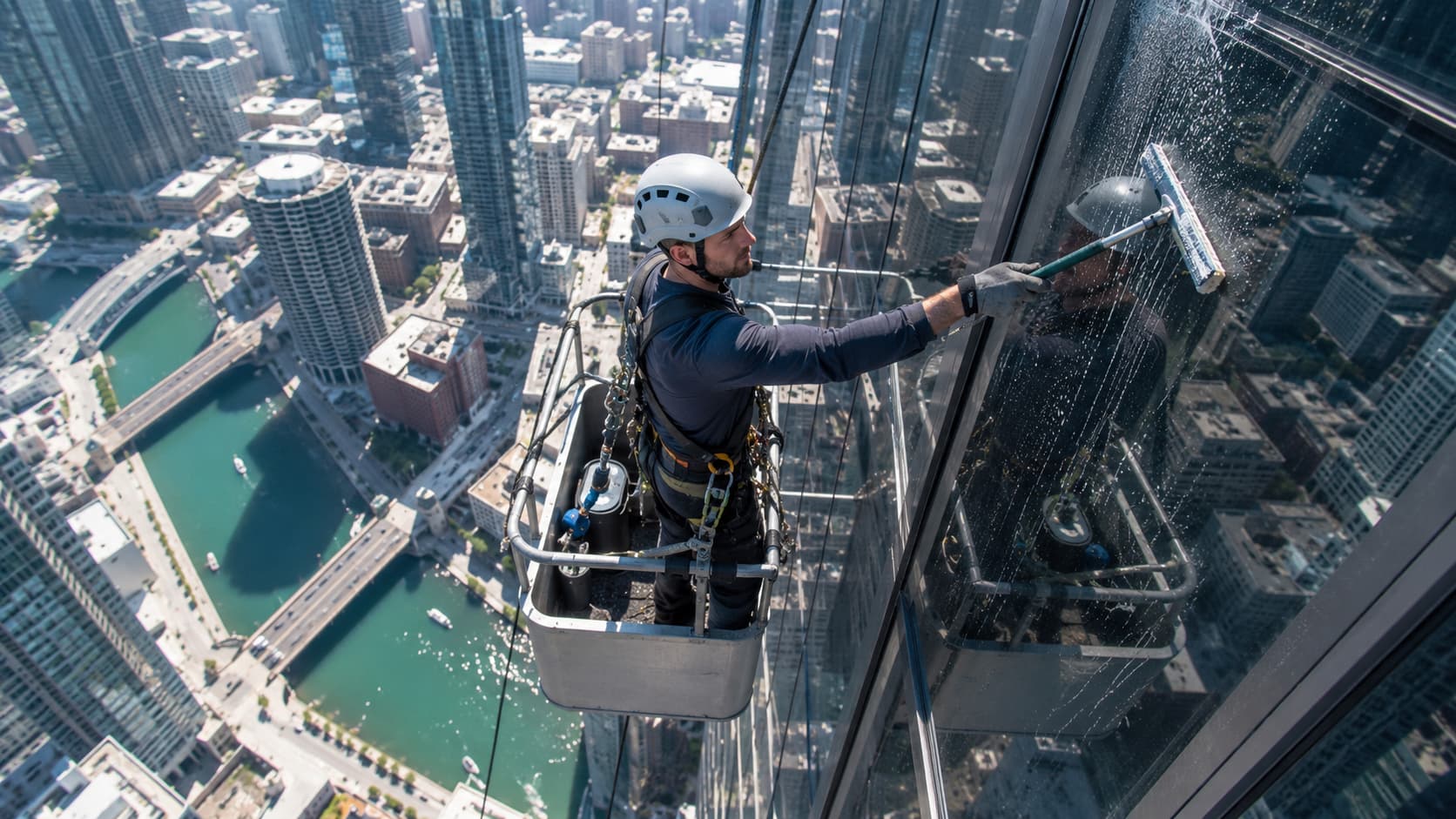
Wind can make exterior high-rise work much more difficult.
A suspended platform sits outside the building, where workers are exposed to conditions that people inside barely notice.
Wind can affect:
- platform movement;
- worker balance;
- control of tools;
- cleaning quality;
- safe positioning.
Weather conditions therefore matter before and during a job.
Rain, extreme temperatures, storms, or high winds can delay exterior work.
A cleaner cannot simply ignore poor conditions because the day’s schedule says the windows need to be finished.
How Dangerous Is High-Rise Window Cleaning?
Falls are the most obvious hazard.
But there are several others.
Equipment Problems
Ropes, cables, anchors, platforms, harnesses, and connectors all have to perform properly.
That makes inspection and maintenance a major part of the work.
Slippery Surfaces
Window cleaning involves water and cleaning solution. Workers still need to handle tools and maintain control of their position.
Falling Objects
A dropped tool can become dangerous when it falls from a tall building.
Workers therefore need procedures for managing equipment and protecting the area below.
Weather
Strong wind, cold, heat, rain, and changing weather conditions can affect safety.
Physical Fatigue
Workers may spend hours repeating arm and shoulder movements while standing, sitting, or hanging in constrained positions.
That can make the job physically demanding even before the psychological challenge of working at height is considered.
Do You Need a College Degree?
A four-year university degree is generally not the typical requirement for building-cleaning work.
BLS says janitors and building cleaners usually do not need formal educational credentials and commonly receive on-the-job training.
High-rise window cleaning, however, involves safety skills that ordinary ground-level cleaning does not.
Depending on the employer and type of work, training may cover areas such as:
- fall protection;
- suspended platforms;
- harness use;
- equipment inspection;
- rope systems;
- emergency procedures;
- workplace communication;
- weather assessment.
Individual employers may also require previous high-rise experience.
For example, some current job listings ask applicants to be comfortable with heights or require prior high-rise window-washing experience.
Do You Have to Be Fearless?
Probably not.
In fact, having no respect for the danger could be a problem.
A professional cleaner needs to remain calm while still taking the risks seriously.
The work rewards people who can follow procedures carefully and resist the temptation to rush.
Someone doing this job needs to be able to concentrate while looking down at streets hundreds of feet below.
For a person with severe fear of heights, that alone could make the occupation unsuitable.
For an experienced worker, however, the height becomes part of a controlled working environment.
How Long Does It Take to Clean a Skyscraper?
There is no single answer.
The time required depends on factors such as:
- building size;
- number of windows;
- shape of the exterior;
- access points;
- crew size;
- weather;
- level of dirt;
- equipment being used.
A smaller high-rise may require far less time than a major downtown tower with thousands of panes.
Some buildings also require repeated exterior cleaning throughout the year.
That means workers can eventually return to the same building and repeat the process all over again.
Why Don’t Robots Do the Job?
Automated exterior-cleaning systems are developing, but buildings are not all simple flat walls.
Skyscrapers may have:
- corners;
- recessed windows;
- ledges;
- signs;
- balconies;
- decorative structures;
- irregular glass panels.
Human cleaners can respond to these conditions as they work.
They can also inspect individual areas of glass and adjust their cleaning method when they encounter stubborn dirt or unusual surfaces.
For that reason, human workers remain a familiar sight on high-rise buildings in many American cities.
Can You Make a Living as a High-Rise Window Cleaner?
Yes, but income varies considerably.
Current job advertisements show that full-time positions exist, including jobs with benefits and paid training. Some listings currently advertise rates in the low-to-mid $20s per hour, while experienced positions can reach higher hourly rates.
A worker earning $25 per hour at a steady 40-hour schedule would gross roughly $52,000 over 52 weeks.
But this simple calculation does not account for:
- overtime;
- unpaid downtime;
- weather cancellations;
- seasonal variations;
- benefits;
- taxes;
- regional differences.
So it is better to think in terms of a pay range than a single national salary.
Is It Worth Doing Such a Dangerous-Looking Job?
That depends on the worker.
Someone who enjoys physical work, dislikes sitting behind a desk, is comfortable at height, and pays close attention to safety may find high-rise exterior cleaning appealing.
The occupation can also offer a route into full-time work without requiring a traditional four-year college education.
But the pay may surprise people who assume that anyone working hundreds of feet above a city must automatically be earning an enormous salary.
Many current jobs appear to pay much more ordinary hourly wages.
And that contrast is part of what makes this occupation so interesting.
Millions of people sit inside tall buildings every day and look through clean glass without thinking much about how the outside surface was washed.
On the other side of that window may be a worker standing on a suspended platform, holding a squeegee while streets, cars, and people appear tiny far below.
For most of us, it would be a terrifying place to spend five minutes.
For a high-rise window cleaner, it is simply another day at work.
