Most people see wind turbines from a highway and barely think about the workers who keep them running.
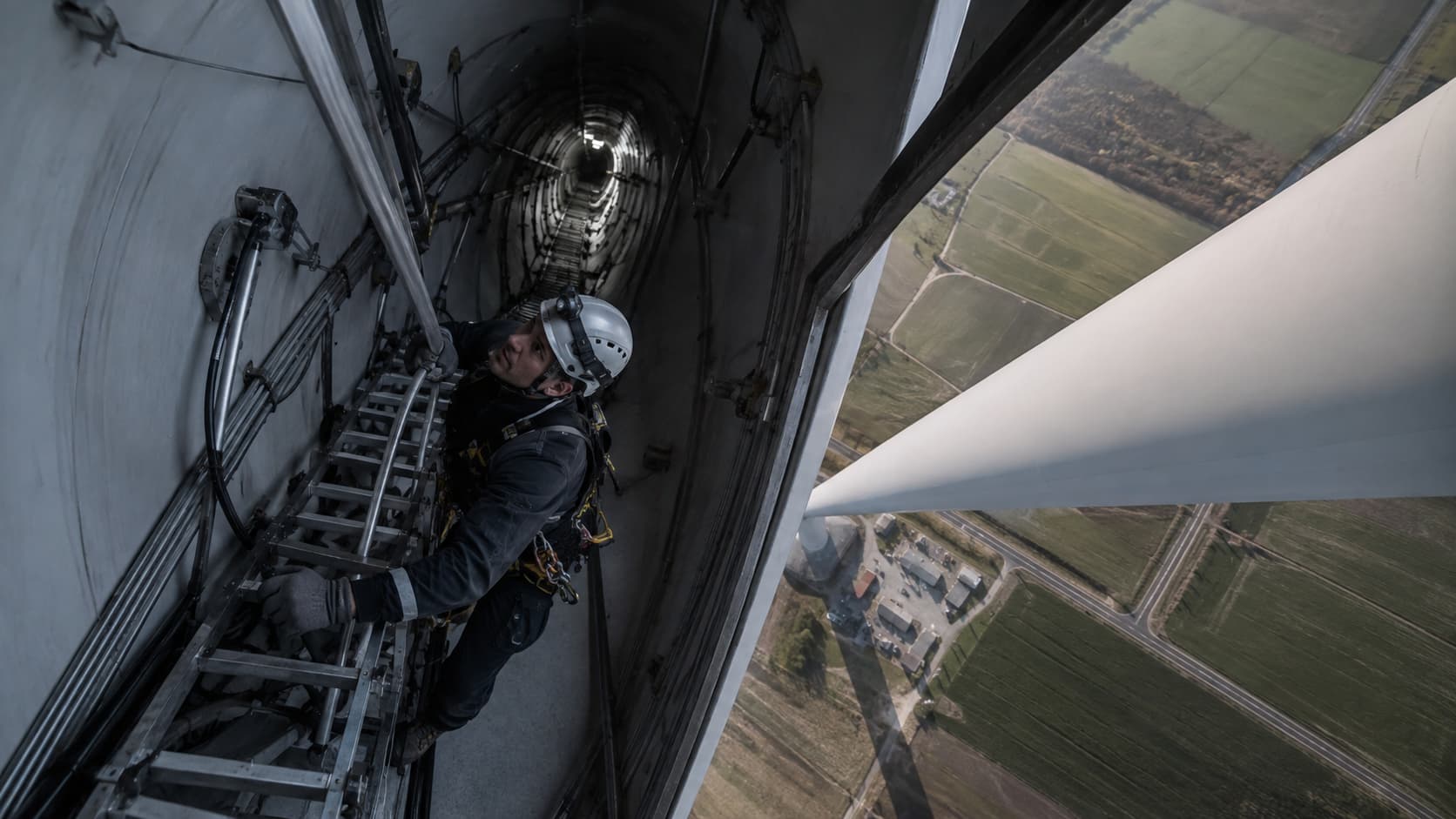
But when one of these machines needs maintenance, someone has to climb inside the tower, reach the machinery high above the ground, diagnose the problem, and repair it.
That person is often a wind turbine service technician, sometimes called a windtech.
It is a job that combines electrical work, mechanical repair, climbing, confined spaces, and exposure to weather — all while working high above the ground.
So what does a wind turbine technician actually do in the United States? How much can they earn? What training is required? And how dangerous is the job?
What Does a Wind Turbine Technician Actually Do?
Wind turbine technicians inspect, maintain, troubleshoot, and repair wind turbines.
O*NET describes the occupation as workers who inspect, diagnose, adjust, or repair wind turbines, including electrical, mechanical, and hydraulic systems.
That means the job can involve much more than climbing a tower and looking at the blades.
Technicians may:
- inspect turbine components;
- test electrical systems;
- troubleshoot faults;
- replace damaged parts;
- service hydraulic systems;
- inspect gearboxes and generators;
- perform scheduled maintenance;
- document problems;
- restart equipment after repairs;
- climb towers to reach machinery inside the nacelle.
The nacelle is the large housing near the top of the turbine that contains major mechanical and electrical components.
For many technicians, that is the real workplace.
How High Do Wind Turbine Technicians Work?
Wind turbines vary greatly in size.
OSHA notes that wind turbines can exceed 100 feet in height, and workers who maintain them may face fall hazards made worse by high winds.
Modern utility-scale turbines can be much taller than that.
This means a technician may spend part of the day climbing dozens of meters before the repair work even begins.
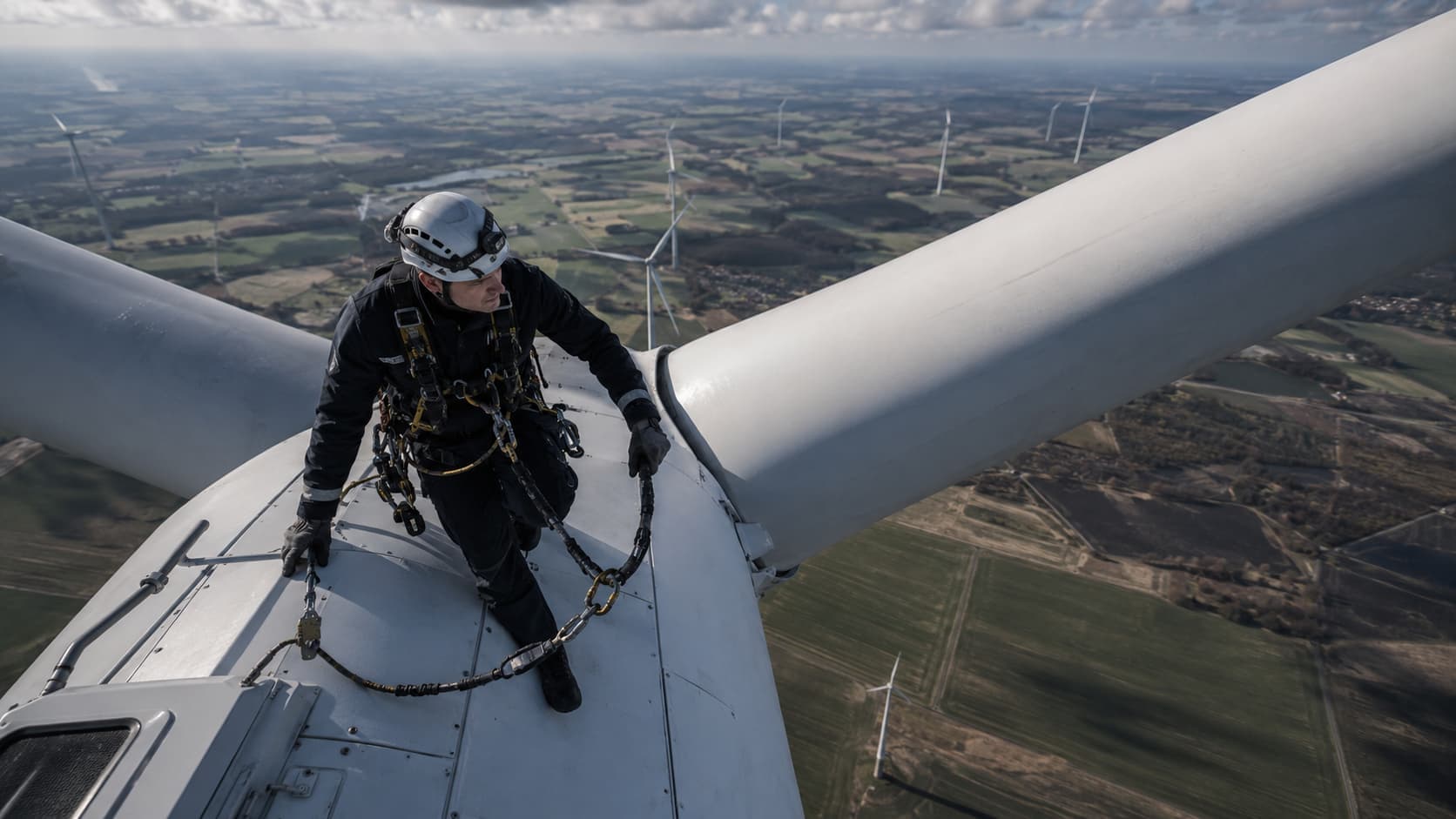
Once at the top, the worker may enter the nacelle, move through tight spaces, or perform tasks near exterior areas while attached to fall-protection systems.
From the ground, the turbine looks enormous.
From the top, roads, vehicles, and buildings can appear tiny.
Does Every Shift Really Begin With a Climb?
Not every assignment requires the same amount of climbing, but climbing is a major part of the occupation.
Technicians may need to ascend the tower to inspect or repair equipment located near the top.
Some turbines have internal ladders, climbing-assist systems, or service lifts.
Even when mechanical assistance is available, technicians still need to be physically capable of climbing and working at elevation.
BLS says wind turbine technicians typically work outdoors, in confined spaces, and at great heights.
That makes physical fitness an important part of the job.
How Much Do Wind Turbine Technicians Make in the U.S.?
Current federal wage data gives a clear benchmark.
O*NET reports that wind turbine service technicians had a 2025 median wage of $30.83 per hour, or $64,120 per year in the United States.
For comparison, BLS reported a median annual wage of $62,580 in May 2024, equivalent to about $30.09 per hour.
The newer 2025 O*NET/BLS wage figure therefore suggests that the occupation has moved slightly higher.
But median pay does not mean every technician earns $64,120.
Actual earnings depend on:
- experience;
- location;
- employer;
- overtime;
- travel;
- certifications;
- type of turbine;
- offshore versus onshore work;
- supervisory responsibility.
Can Experienced Wind Turbine Technicians Earn More?
Yes.
Historical BLS wage distribution data shows a wide range.
For 2024, O*NET’s wage table reported that the lowest 10% of workers earned around $49,110 or less, while the highest 10% earned about $88,090 or more.
More recent 2025 data published through O*NET places the national median at $64,120.
Some states and remote regions may pay more because employers need technicians who are willing to travel or work in harder-to-staff locations.
For example, earlier O*NET/BLS state data showed upper-end pay in some North Dakota areas approaching or exceeding the mid-$90,000 range.
That does not mean a new technician should expect that salary immediately.
But it shows that experienced workers can move well above the national median.
Can Wind Turbine Technicians Make $100,000 a Year?
It is possible for some workers, but it is not the standard wage.
A technician might approach or exceed six figures through a combination of:
- experience;
- overtime;
- travel pay;
- remote assignments;
- offshore work;
- leadership duties;
- specialized technical skills.
The median remains much lower, at about $64,120 in 2025.
So social-media claims such as:
“Wind turbine technicians make $100,000 just for climbing towers.”
leave out too much context.
A small portion of experienced workers may earn that amount.
Most workers are closer to the occupational wage range reported by federal data.
What Does a Typical Day Look Like?
A technician’s day may begin at a wind farm rather than inside a traditional workshop.
Before climbing, the crew may review:
- weather;
- maintenance schedules;
- safety procedures;
- fault reports;
- electrical status;
- equipment needed for the job.
The technician may then prepare tools and protective equipment.
After reaching the turbine, the crew may climb inside the tower.
At the top, technicians inspect systems such as:
- electrical wiring;
- control systems;
- hydraulic equipment;
- gearboxes;
- generators;
- braking systems;
- sensors.
If a turbine has stopped operating, technicians may need to identify the cause before replacing any parts.
This can mean testing multiple systems rather than simply replacing one obvious component.
Do Technicians Work Inside the Blades?
Usually, much of the work is concentrated inside the tower and nacelle rather than inside the blade itself.
But technicians may inspect blades or assist with blade-related maintenance.
Some specialized workers perform rope-access blade inspections or repairs.
The standard wind turbine service technician, however, spends much of the job working with the turbine’s mechanical, electrical, hydraulic, and control systems.
O*NET specifically lists diagnosing electrical, mechanical, and hydraulic malfunctions as a core part of the occupation.
Is the Job Physically Demanding?
Yes.
Technicians may have to:
- climb;
- kneel;
- crouch;
- carry tools;
- lift equipment;
- work in narrow spaces;
- remain on their feet for long periods;
- work outdoors in changing weather.
The work can be tiring before the actual repair even begins.
Climbing inside a tall turbine while carrying safety equipment and tools requires strength and stamina.
The job may be especially difficult for someone uncomfortable with heights or confined spaces.
What Are the Biggest Risks?
Wind turbine work combines several industrial hazards.
OSHA identifies serious risks including falls, electrical shock, arc flash, fire, and crushing injuries.
Falls
Technicians work at significant height.
OSHA warns that wind exposure can make elevated work even more hazardous.
Fall-protection systems, harnesses, anchors, and climbing procedures are therefore critical.
Electrical Hazards
Wind turbines contain electrical systems capable of causing serious injury.
OSHA specifically lists electric shock and arc flash among the hazards faced by wind-energy workers.
One OSHA accident report describes a technician who suffered severe burns when an electrical fault caused an arc while he was replacing a fuse holder.
Moving Machinery
A turbine contains many mechanical components.
Unexpected movement or startup can create crushing or entanglement hazards.
This is why maintenance work often requires hazardous-energy control procedures.
OSHA states that employers must follow lockout/tagout procedures to prevent unexpected startup or release of stored energy during servicing.
Confined Spaces
Some areas inside turbines can be narrow and difficult to enter or exit.
OSHA warns that confined spaces may create risks such as restricted escape routes, low oxygen, or hazardous atmospheres.
Fire
Wind turbines contain electrical components, insulation, lubricants, and other materials that can create fire hazards inside the nacelle.
Fire becomes especially serious when workers are hundreds of feet above the ground.
What Happens When the Wind Gets Too Strong?
Wind is obviously part of the environment.
But too much wind can make work unsafe.
Strong gusts can affect:
- climbing;
- balance;
- exterior movement;
- handling tools;
- lifting materials;
- rescue operations.
OSHA regulations recognize that wind may blow a worker from an elevated position or cause workers to lose control of materials.
Technicians and employers therefore monitor weather carefully.
A turbine may be producing power because the wind is strong, but that does not mean it is automatically safe for a technician to work outside the nacelle.
Do You Need a College Degree?
Usually not a four-year degree.
BLS says wind turbine service technicians typically need a postsecondary nondegree award, often from a technical school or community college.
Programs may focus on subjects such as:
- electricity;
- hydraulics;
- mechanical systems;
- turbine technology;
- safety;
- troubleshooting.
Technicians also commonly receive substantial on-the-job training.
This makes windtech work a skilled technical career rather than a traditional university-based profession.
How Long Does Training Take?
Training paths vary.
Many people complete a technical program before entering the occupation.
After being hired, technicians continue learning on the job because different turbine manufacturers and models use different systems.
New workers may spend time learning:
- climbing procedures;
- rescue methods;
- electrical troubleshooting;
- mechanical repair;
- turbine controls;
- safety systems;
- maintenance documentation.
The ability to work safely at height is just as important as knowing how to repair machinery.
Do You Have to Be Good With Electricity?
Electrical knowledge is a major part of the occupation.
Wind turbines contain:
- sensors;
- control systems;
- generators;
- electrical panels;
- cables;
- switches;
- power-conversion equipment.
A technician may need to test circuits and determine whether a failure is electrical, mechanical, or hydraulic.
That is one reason windtech training covers several technical disciplines rather than only one trade.
What Happens if a Turbine Breaks Down?
When a turbine reports a fault, technicians may receive diagnostic information from remote monitoring systems.
But a computer alert does not always identify the exact failed component.
The technician may still need to climb the turbine and inspect the equipment.
They might:
- review the fault code;
- shut down and secure the turbine;
- inspect affected systems;
- test components;
- replace or repair the damaged part;
- restart the turbine;
- confirm that it is operating correctly.
A turbine that is not producing electricity is not generating revenue.
That makes efficient repair important for wind-farm operators.
Do Wind Technicians Travel?
Some do.
A technician employed by a single wind farm may work mainly at one location.
Other workers may travel between wind farms or service turbines across a larger region.
Travel can become more common for:
- major repairs;
- commissioning new turbines;
- specialized maintenance;
- emergency work;
- manufacturer service teams.
Remote wind farms can also mean long drives and work in rural areas far from major cities.
What States Have Wind Turbine Technician Jobs?
Wind-turbine jobs tend to be concentrated in areas with significant wind-energy development.
That includes parts of:
- Texas;
- Iowa;
- Oklahoma;
- Kansas;
- Colorado;
- Illinois;
- North Dakota;
- South Dakota;
- Minnesota.
Jobs can also exist in other states as wind development expands.
The exact employment pattern changes over time, so anyone considering the occupation should check current state-level data and local job postings.
Is Wind Turbine Technician a Growing Career?
Very much so.
This is one of the most notable parts of the occupation.
BLS projects employment of wind turbine service technicians to grow about 50% from 2024 to 2034.
That places the occupation among the fastest-growing jobs in the United States.
BLS projects employment to rise from about 13,600 jobs in 2024 to around 20,500 by 2034.
The occupation is still relatively small in absolute numbers.
But the growth rate is unusually high.
Why Is Demand Growing So Fast?
As more wind turbines are installed, more technicians are needed to keep them operating.
A turbine may remain in service for years and requires recurring inspection and maintenance.
That means new wind-energy construction does more than create installation work.
It also creates long-term maintenance demand.
Every new wind farm adds machinery that will eventually need:
- inspection;
- troubleshooting;
- component replacement;
- preventive maintenance.
That ongoing service requirement supports technician employment.
Is This a Good Career Without a Four-Year Degree?
For some people, yes.
Wind turbine technician is unusual because it combines several characteristics that job seekers often look for:
- technical work;
- relatively strong pay;
- no typical four-year degree requirement;
- rapid projected employment growth;
- outdoor work;
- mechanical and electrical skills.
But the occupation also has clear tradeoffs.
You need to be comfortable with:
- heights;
- climbing;
- weather;
- confined spaces;
- electrical hazards;
- physically demanding work.
A person who wants an office job with predictable indoor conditions probably will not enjoy it.
A person who likes technical problem-solving and does not mind climbing hundreds of feet may see it very differently.
So How Much Are They Really Paid to Work Hundreds of Feet Above the Ground?
Current federal data places median U.S. pay for wind turbine service technicians at about $64,120 per year, or $30.83 per hour, in 2025.
Some experienced technicians can earn substantially more.
New workers may earn less.
And overtime, location, travel, and specialization can significantly affect total earnings.
The job is not simply:
“Get paid to climb wind turbines.”
It requires knowledge of electrical systems, hydraulics, mechanics, safety, troubleshooting, and industrial maintenance.
The view from the top may be dramatic.
But when a turbine stops working, the technician still has to find the problem and fix it — sometimes hundreds of feet above the ground.
For most people, standing at the top of a wind turbine would be the most frightening part of the day.
For a windtech…
that may be where the real work finally begins.
