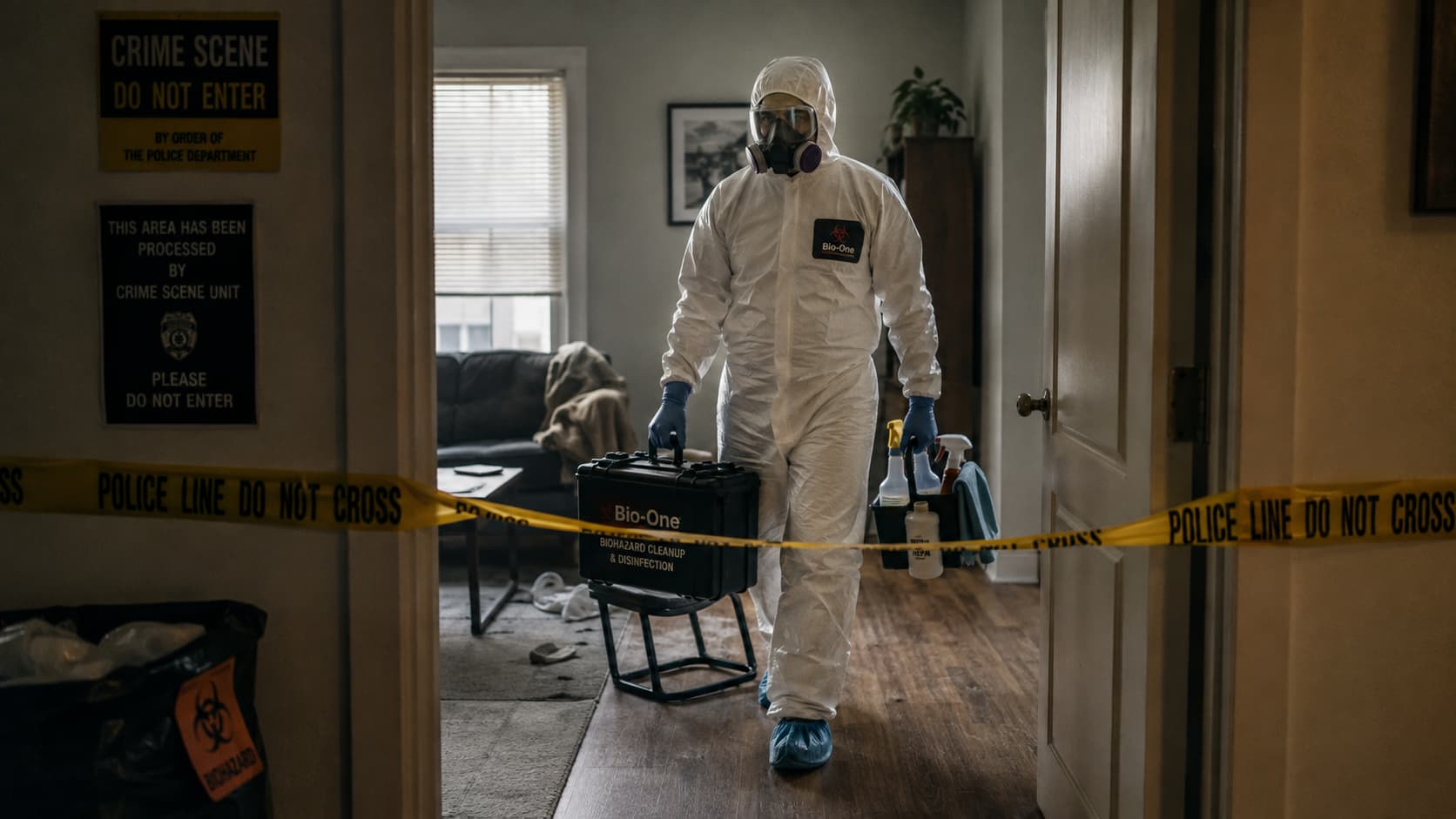
When police officers and investigators finish their work at a crime scene, the room does not simply return to normal.
Someone may still have to clean it.
Crime scene cleaners enter homes, apartments, businesses, vehicles, and other locations after law enforcement has released the scene. Their job can involve removing contaminated materials, disinfecting surfaces, controlling odors, disposing of biological waste, and making the space safe again.
It is not ordinary house cleaning.
Workers may be exposed to blood, body fluids, contaminated objects, sharp materials, strong cleaning chemicals, and emotionally difficult environments.
So what does a crime scene cleaner actually do in the United States? How much can they earn? What training do they need? And what makes this job so difficult?
What Does a Crime Scene Cleaner Actually Do?
The occupation is often described as crime scene cleanup, biohazard remediation, or trauma scene cleanup.
The worker normally arrives after police, forensic investigators, emergency responders, or other authorities have finished at the location.
They are not collecting fingerprints.
They are not looking for evidence.
They are there to clean and remediate the property.
Depending on the situation, the job may involve:
- cleaning contaminated surfaces;
- removing blood or other biological material;
- disinfecting floors, walls, and furniture;
- removing contaminated carpet or flooring;
- packaging affected materials;
- controlling strong odors;
- removing damaged furniture;
- cleaning vehicles;
- handling sharps or contaminated objects;
- preparing regulated waste for proper disposal.
Some jobs can be completed relatively quickly.
Others require workers to remove sections of flooring, drywall, furniture, or other materials because contamination has moved below the visible surface.
Do Crime Scene Cleaners Work for the Police?
Usually not.
This is a common misconception.
Police investigate the incident.
Crime scene cleaners deal with the property afterward.
A cleanup company may be hired by:
- a homeowner;
- a landlord;
- a property-management company;
- a business;
- an insurance company;
- a family;
- another organization responsible for the property.
The cleaner may arrive only after authorities have officially released the location.
This is why the job can begin at the exact moment most people assume the scene is finished.
For investigators, the work may be over.
For the cleanup crew, it is just beginning.
How Much Do Crime Scene Cleaners Make in the U.S.?
There is no separate Bureau of Labor Statistics occupation called “crime scene cleaner.”
That makes salary estimates less precise than they are for occupations such as electricians or wind turbine technicians.
A useful federal comparison is hazardous materials removal workers, because those workers remove and dispose of substances that can create health risks.
BLS reported a median annual wage of $48,490 in May 2024 for hazardous materials removal workers. The lowest 10% earned less than $37,330, while the highest 10% earned more than $82,480.
Crime scene cleanup does not perfectly match that federal category, so those numbers should be treated as a benchmark rather than an official crime-scene-cleaner salary.
Private salary estimates vary considerably.
ZipRecruiter estimated average U.S. pay for its broader Crime Scene Cleanup category at about $60,392 per year, or $29.03 per hour, in July 2026. Its estimates are based on job postings and third-party data rather than an official federal occupational category.
That difference between federal occupational data and private salary estimates is important.
There simply is not one official number that every crime scene cleaner earns.
Can Crime Scene Cleaners Make $60,000 or More?
Yes, some can.
But income depends heavily on the employer and type of work.
Factors can include:
- location;
- experience;
- overtime;
- on-call work;
- overnight assignments;
- supervisory duties;
- hazardous-material responsibilities;
- certifications;
- travel;
- size of the cleanup company.
Workers who take emergency calls at night, on weekends, or during holidays may have a different earnings pattern from someone working regular daytime hours.
Some technicians may also perform more than crime scene cleanup.
Their employer may handle:
- unattended-death cleanup;
- accident cleanup;
- hoarding properties;
- sewage contamination;
- biohazard remediation;
- vehicle decontamination;
- infectious-material cleanup.
That wider range of work can affect both schedule and pay.
Why Isn’t There an Official Crime Scene Cleaner Salary?
Because the federal government classifies occupations according to broader types of work.
“Crime scene cleaner” is a relatively narrow specialty.
Many people doing this work may be classified under cleaning, hazardous-material removal, remediation, or related occupations.
That means viral statements such as:
“Crime scene cleaners make $100,000 a year.”
need context.
A particular owner, supervisor, specialist, or worker doing large amounts of overtime might reach high earnings.
That does not make $100,000 the normal salary for every technician.
A more realistic way to discuss the occupation is to show a range and explain why pay varies.
What Does a Typical Crime Scene Cleanup Look Like?
The first step is usually not cleaning.
It is assessment.
Workers need to determine:
- which areas are contaminated;
- what protective equipment is required;
- which materials can be cleaned;
- which materials need to be removed;
- what waste-handling procedures apply.
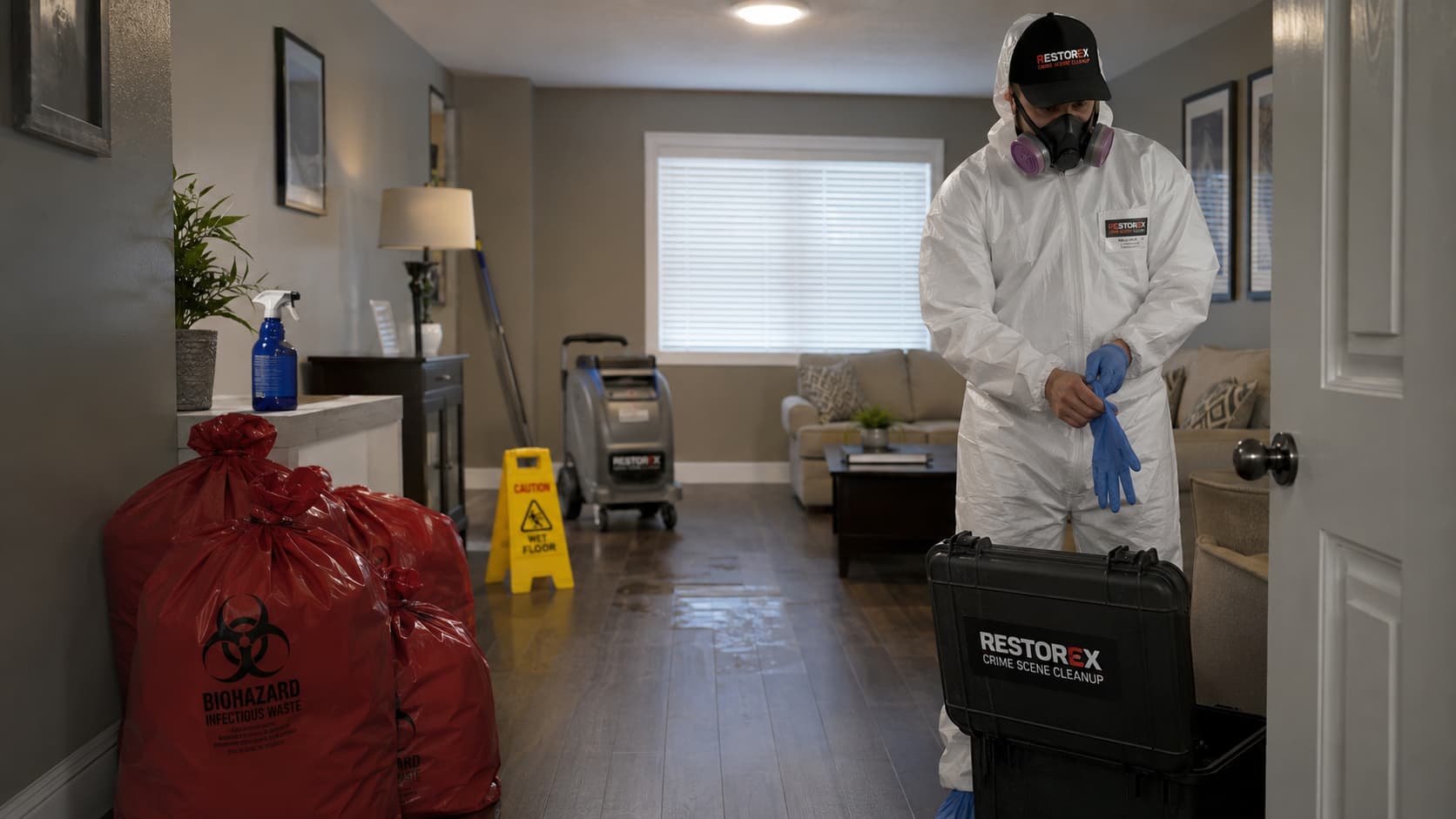
The crew then prepares protective equipment.
That may include:
- disposable coveralls;
- gloves;
- eye protection;
- face protection;
- respiratory protection when appropriate;
- protective footwear.
The exact equipment depends on the hazards at the location.
Once workers enter the affected area, they may divide the scene into different zones to reduce the risk of carrying contamination into clean areas.
Why Do They Wear Full Protective Suits?
Because biological contamination can create occupational health risks.
OSHA’s Bloodborne Pathogens Standard applies when workers may have occupational exposure to blood or other potentially infectious materials. OSHA has specifically stated that the standard can apply to employees performing cleanup work involving those hazards.
Bloodborne pathogens can include organisms associated with diseases such as hepatitis B, hepatitis C, and HIV.
Protective equipment creates a barrier between the worker and potentially contaminated material.
Depending on the situation, this may involve gloves, protective clothing, eye protection, or other PPE.
OSHA requires appropriate personal protective equipment when exposure to blood or other potentially infectious material is anticipated.
Is Blood the Only Hazard?
No.
Workers may encounter several types of risk at one location.
These can include:
Biological Material
Blood and certain body fluids may contain infectious microorganisms.
Sharps
Broken glass, needles, blades, or other sharp objects may create puncture or cut hazards.
Cleaning Chemicals
Strong disinfectants and cleaning products can create their own risks if handled incorrectly.
Odors
Some scenes involve severe odors that require specialized treatment.
Structural Damage
Floors, walls, furniture, or other surfaces may already be damaged.
Emotional Stress
The location may belong to a family that has just experienced a traumatic event.
So the worker has to manage both physical hazards and an emotionally sensitive environment.
Do They Just Spray Disinfectant and Wipe Everything Down?
No.
Visible cleaning is only one part of the job.
Biological material can move into:
- carpet padding;
- floorboards;
- wall material;
- furniture;
- cracks;
- porous surfaces.
If contamination has penetrated material that cannot be properly cleaned, part of the structure may need to be removed.
For example, a technician may need to remove:
- carpet;
- padding;
- sections of flooring;
- drywall;
- furniture;
- mattresses;
- other porous materials.
That is why some cleanup jobs can take many hours or longer.
The goal is not simply to make the room look clean.
The goal is to address contamination safely.
What Happens to Contaminated Materials?
They cannot always be placed in normal household trash.
Waste requirements vary by the type of material and by state.
EPA states that medical waste is primarily regulated by state environmental and health departments, rather than under one single federal medical-waste system.
That means cleanup companies need to understand the requirements that apply where they operate.
Certain materials may need to be:
- packaged correctly;
- labeled;
- transported according to applicable rules;
- delivered to an authorized treatment or disposal facility.
This is one reason professional biohazard cleanup involves far more than cleaning supplies.
How Long Can One Cleanup Take?
There is no standard duration.
A relatively small area may take a few hours.
A larger or more complicated scene may require far longer.
The time depends on factors such as:
- size of the contaminated area;
- type of material;
- how long contamination has been present;
- whether it reached flooring or walls;
- amount of furniture involved;
- odor;
- number of workers;
- waste-removal requirements.
A room that looks relatively normal at first glance can require major work once technicians determine what has moved beneath the visible surface.
Do Crime Scene Cleaners Work at Night?
They can.
This is not always a predictable Monday-to-Friday occupation.
Incidents can happen:
- overnight;
- early in the morning;
- on weekends;
- during holidays.
Some cleanup companies provide 24-hour response services.
That may mean technicians have on-call schedules.
A worker could finish one job and then receive another call later that evening.
This unpredictability is one of the less visible parts of the occupation.
Do You Need a College Degree?
Usually, a traditional four-year degree is not the central requirement.
For the broader hazardous-material-removal occupation, BLS says workers typically enter with a high school diploma or equivalent and receive on-the-job training.
Crime scene cleanup companies may have their own hiring standards.
New workers may need training related to:
- bloodborne pathogens;
- personal protective equipment;
- respiratory protection;
- chemical safety;
- hazardous-material handling;
- waste procedures;
- decontamination;
- equipment use.
Requirements can also differ by state and by the exact type of waste being handled.
Is There a Special Crime Scene Cleaner License?
There is no single nationwide “crime scene cleaner license” that applies identically everywhere in the United States.
Rules can depend on the state and on the activities performed.
Medical and biohazardous waste rules are largely handled at the state level. EPA specifically advises contacting state environmental and health agencies for information about applicable medical-waste requirements.
Companies may also need to comply with OSHA workplace-safety standards when employees can be exposed to bloodborne pathogens or other occupational hazards.
Someone interested in entering the field should therefore check requirements in the state where they plan to work rather than relying on a single national checklist.
What Is the Hardest Part of the Job?
Many people assume the hardest part is seeing the scene.
That can certainly be difficult.
But the emotional side of the occupation may go beyond the physical cleanup.
Workers may arrive at someone’s:
- home;
- bedroom;
- apartment;
- family property.
The people they meet may be grieving, shocked, or overwhelmed.
A cleaner therefore needs more than technical skills.
Professional behavior matters.
Workers may need to remain calm, respectful, and discreet while doing a difficult job around people experiencing one of the worst days of their lives.
Do Workers Become Used to It?
Experience can make someone more familiar with the procedures.
That does not necessarily mean the emotional impact disappears.
Repeated exposure to traumatic environments can be difficult for some people.
Different workers handle this in different ways.
A person considering the career should think seriously about whether they can work calmly around distressing situations while still completing detailed safety procedures.
The occupation demands emotional control as well as physical stamina.
Is Crime Scene Cleanup Dangerous?
It can involve meaningful occupational risks.
The most important are not the dramatic dangers shown in movies.
They are often quieter:
- contact with infectious material;
- sharps injuries;
- improper PPE use;
- contaminated surfaces;
- chemical exposure;
- incorrect waste handling.
OSHA requires universal precautions where occupational exposure to blood or other potentially infectious materials can occur. Under these precautions, relevant blood and body fluids are treated as potentially infectious.
That is why trained workers approach a scene differently from someone doing ordinary household cleaning.
Is Crime Scene Cleanup the Same as Forensic Work?
No.
A forensic science technician works with evidence related to criminal investigations.
A cleanup technician enters after the investigative process at the location has ended.
The distinction is simple:
Forensics asks: What happened here?
Cleanup asks: How do we make this property safe again?
The jobs may occur in the same room, but they serve very different purposes.
Is This a Full-Time Career?
It can be.
Some companies specialize in trauma and biohazard remediation.
Others combine crime scene cleanup with several related services.
A technician may therefore work on different types of incidents throughout the year rather than only criminal cases.
The occupation can involve:
- scheduled work;
- emergency calls;
- travel;
- evening work;
- weekend assignments.
For someone entering the field, the broader biohazard-remediation industry may offer more employment opportunities than searching only for jobs titled “crime scene cleaner.”
Is Crime Scene Cleanup Worth Considering as a Career?
It depends heavily on the person.
The work may suit someone who:
- stays calm under pressure;
- follows safety procedures carefully;
- is comfortable wearing protective equipment;
- can handle unpleasant environments;
- does not mind irregular schedules;
- can work respectfully around grieving families.
It is probably a poor fit for someone who becomes easily overwhelmed by traumatic environments or dislikes working with contamination.
The occupation is unusual because its most important work happens after everyone else has left.
There may be no cameras.
No police lights.
No investigators.
Just a room that still needs to be made safe.
So How Much Are Crime Scene Cleaners Really Paid?
There is no official federal wage specifically for crime scene cleanup.
The closest federal comparison, hazardous materials removal workers, had a median annual wage of $48,490 in May 2024, with the highest 10% earning more than $82,480.
Private salary estimates can be higher. ZipRecruiter estimated about $60,392 per year, or $29.03 per hour, for its Crime Scene Cleanup category in July 2026.
The safest conclusion is that pay varies substantially by employer, location, experience, overtime, on-call work, and the exact type of remediation being performed.
It is not a job where one viral salary number tells the whole story.
And the money is only one part of the occupation.
When police tape comes down and investigators leave, someone may still have to walk through that door.
They put on protective equipment.
They remove what cannot be saved.
They disinfect what can.
And when they finally leave, the goal is simple:
to make a difficult place safe for someone to enter again.
