When the power goes out after a storm, most people wait indoors for the lights to come back on.
Electrical lineworkers are often the people outside trying to make that happen.
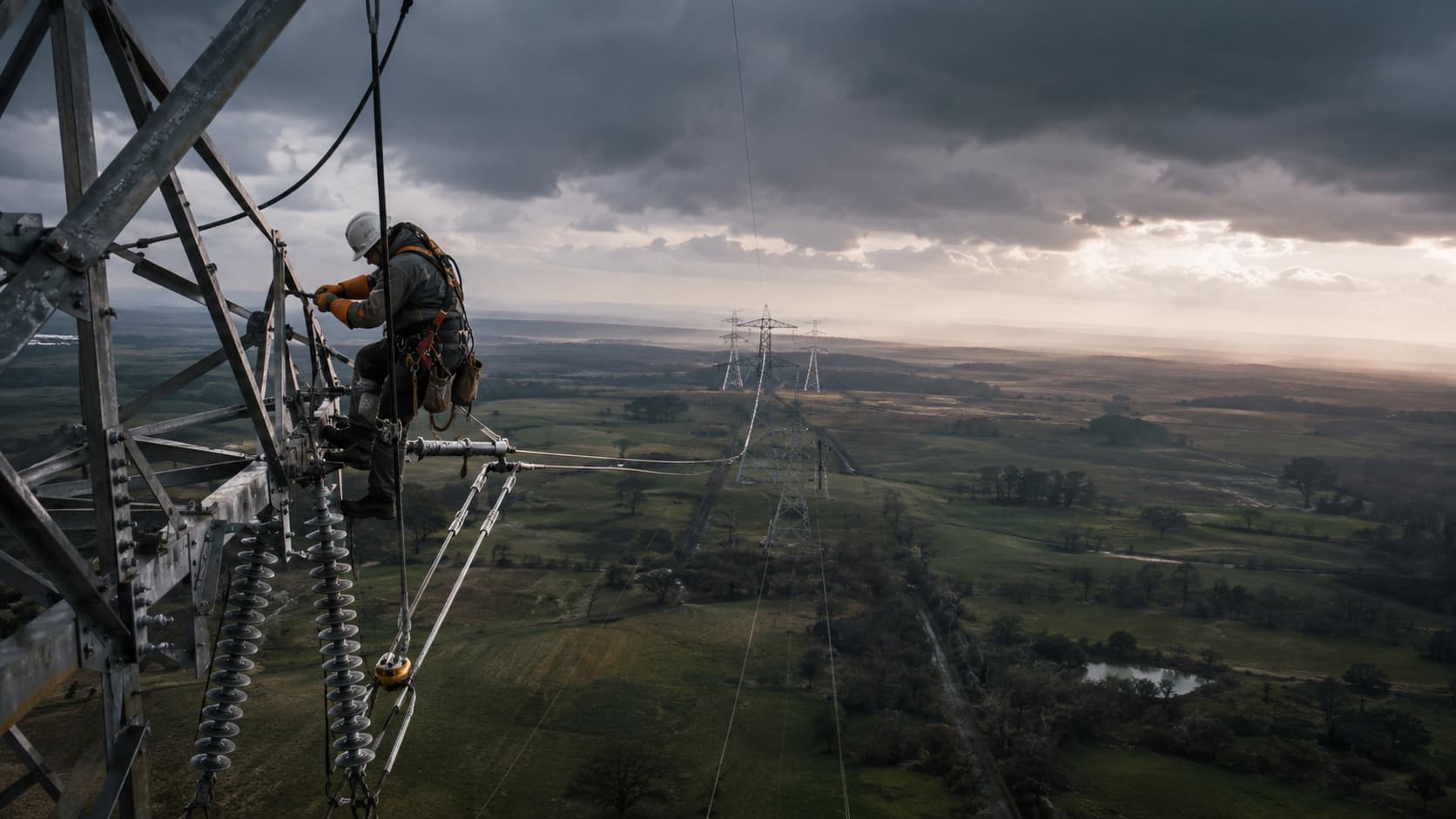
They climb utility poles and transmission towers, work from bucket trucks, repair damaged lines, replace electrical equipment, and sometimes perform these jobs around high-voltage systems while standing dozens of feet above the ground.
It is physically demanding work with obvious risks.
But it can also be one of the better-paying skilled trades in the United States.
So what do electrical lineworkers actually do? How much can they earn? What training is required? And how dangerous is the job?
What Does an Electrical Lineworker Actually Do?
The official federal occupation is called Electrical Power-Line Installers and Repairers.
O*NET describes these workers as people who install or repair cables and wires used in electrical power or distribution systems. They may also erect utility poles and transmission towers.
Their work helps maintain the electrical grid that carries power from generating facilities to homes, businesses, and other customers.
A lineworker may spend the day:
- installing new electrical lines;
- repairing damaged wires;
- replacing insulators;
- working on transformers;
- installing switches and voltage regulators;
- testing electrical equipment;
- replacing damaged poles;
- climbing transmission towers;
- responding to power outages;
- restoring service after storms.
BLS notes that lineworkers employed by local utilities may maintain transformers, voltage regulators, switches, street lights, and traffic lights, while transmission crews may travel across a region to maintain larger power-grid infrastructure.
How Much Do Electrical Lineworkers Make in the U.S.?
This occupation pays considerably more than many other jobs that typically require only a high school diploma at entry.
According to the U.S. Bureau of Labor Statistics, the median annual wage for electrical power-line installers and repairers was $92,560 in May 2024.
That equals about:
$44.50 per hour.
Median pay means half of workers earned more than that amount and half earned less.
The wage range is also wide.
BLS reported that:
- the lowest 10% earned less than $50,020 per year;
- the highest 10% earned more than $126,610 per year.
That means experienced lineworkers, especially those working substantial overtime or in higher-paying markets, may reach six-figure annual earnings.
Can a Lineworker Really Make More Than $100,000 a Year?
Yes.
Unlike many unusual-job salary claims online, six-figure earnings are clearly supported by federal wage data for this occupation.
BLS reports that the top 10% of electrical power-line installers and repairers earned more than $126,610 in 2024.
But this does not mean every new lineworker will immediately earn $100,000.
Pay depends on factors such as:
- experience;
- employer;
- location;
- overtime;
- union agreements;
- storm-response work;
- transmission versus distribution work;
- supervisory responsibilities.
A worker may also earn more in a year with heavy overtime than in a normal schedule.
Why Can the Pay Be So High?
Several factors help explain the compensation.
The job requires technical knowledge and long-term training.
It also involves:
- working at height;
- high-voltage electricity;
- emergency response;
- physically demanding tasks;
- outdoor work in difficult weather;
- irregular schedules;
- travel during major outages.
In addition, power-grid failures cannot always wait until the next convenient workday.
When a storm knocks out electricity to thousands of homes, crews may need to begin repairs immediately.
That urgency can create long shifts and substantial overtime.
What Does a Typical Day Look Like?
There is no single routine.
A lineworker might spend one day installing new infrastructure and the next responding to an outage.
Before beginning work, crews may review:
- work orders;
- system conditions;
- electrical hazards;
- weather;
- equipment requirements;
- crew responsibilities;
- safety procedures.
Workers then prepare equipment such as:
- insulated gloves;
- fall-protection equipment;
- climbing gear;
- bucket trucks;
- electrical testing equipment;
- specialized hand tools;
- protective clothing.
Depending on the job, they may climb a pole, work from an aerial bucket, or access a transmission structure.
The actual repair may involve replacing damaged equipment, reconnecting conductors, testing circuits, or installing new hardware.
Precision matters because the systems they work around can carry extremely high voltage.
Do Lineworkers Always Climb Poles?
No.
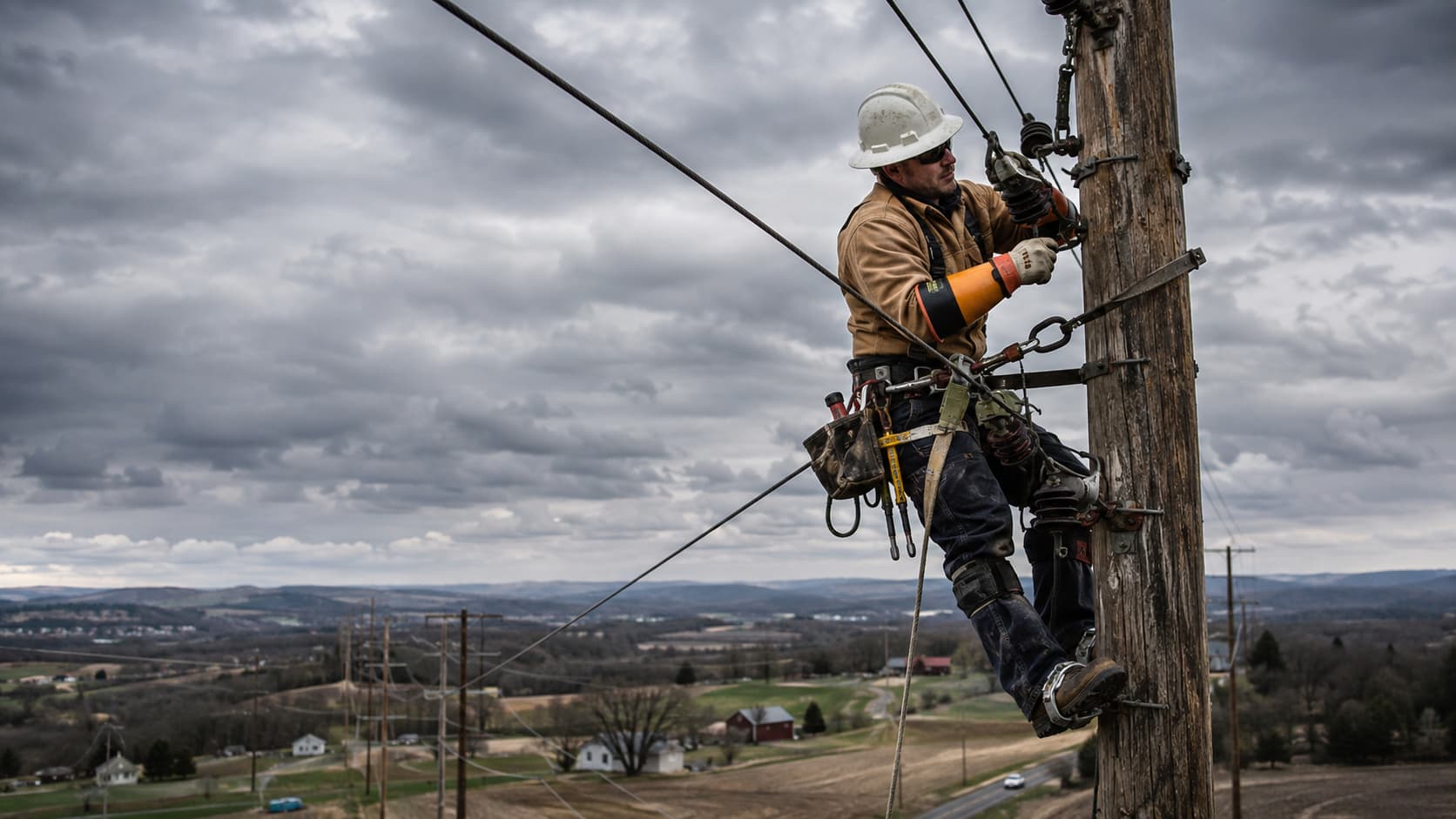
Pole climbing remains an important skill, but modern crews often work from truck-mounted aerial lifts or bucket trucks.
BLS specifically notes that electrical power-line installers and repairers use truck-mounted buckets to reach electrical equipment.
However, workers still need to be comfortable climbing poles and transmission towers.
Some locations cannot easily be reached by a bucket truck.
Storm damage may also occur in areas where normal vehicle access is difficult.
BLS says lineworkers need to be capable of climbing utility poles and transmission towers and maintaining balance while working at height.
Do They Work on Live Power Lines?
Sometimes.
But this part of the occupation requires carefully controlled procedures.
BLS states that workers may encounter live high-voltage cables and use electrically insulated protective devices and tools when working around energized lines.
A worker does not simply climb a pole and touch a live conductor.
Depending on the job, crews may:
- de-energize equipment;
- isolate circuits;
- establish grounding;
- maintain required approach distances;
- use insulated gloves;
- use specialized tools;
- follow energized-work procedures.
OSHA warns that overhead power lines can carry extremely high voltage and that contact may result in fatal electrocution. Burns and falls are also major hazards.
Can Electricity Hurt a Worker Without Direct Contact?
Yes.
High-voltage electricity can create an arc through the air when conditions allow.
OSHA warns that working too close to an energized line may expose someone to an electric arc capable of causing burns, shock, or electrocution even without physically touching the line.
That is why required approach distances and protective procedures matter.
For workers dealing with high-voltage systems, being “almost clear” of the line may not be safe enough.
What Are the Biggest Risks?
Electrical linework combines several serious hazards.
Electrical Shock and Electrocution
This is the most obvious risk.
BLS says workers can be electrocuted if they contact live high-voltage cables.
OSHA also identifies fatal electrocution as the primary danger associated with power-line contact.
Falls
Lineworkers frequently work high above the ground.
A fall from a utility pole, tower, or aerial lift can be fatal.
BLS states that workers use fall-protection equipment when working on poles and towers.
Electrical Burns
An electrical arc can produce extreme heat.
A worker may suffer severe burns even if the incident does not result in fatal electrocution.
Falling Equipment
Tools, equipment, or pieces of damaged infrastructure can create hazards for workers below.
Weather
Lineworkers may work outdoors in rain, wind, heat, cold, snow, or other difficult conditions.
This is especially common during emergency restoration work.
What Happens After a Major Storm?
This is when the occupation often becomes most visible to the public.
A hurricane, ice storm, tornado, or major thunderstorm can damage:
- poles;
- conductors;
- transformers;
- transmission equipment;
- switches;
- distribution systems.
Line crews may travel into affected areas to restore power.
BLS says workers may need to travel long distances and work long hours for several consecutive days after storms or natural disasters.
A storm-restoration shift can therefore look very different from a normal maintenance day.
Workers may remain on duty for extended hours while thousands of customers wait for electricity to return.
Do Lineworkers Work More Than 40 Hours a Week?
Many do at least some of the time.
BLS states that most electrical power-line installers and repairers work full time, and some work more than 40 hours per week.
Emergency outages can create longer schedules.
This matters when discussing annual income.
A lineworker earning a strong base hourly wage may earn significantly more through overtime.
That is one reason some workers report annual earnings well above the occupation’s median.
Do You Need a College Degree?
Usually not a four-year college degree.
BLS says lineworkers typically need a high school diploma or equivalent to enter the occupation.
But entering the field does not mean someone is immediately qualified to perform every task.
The occupation requires technical instruction and substantial on-the-job training.
Apprenticeships are common.
This makes linework a skilled trade rather than an occupation someone learns in a few days.
What Does Lineman Training Include?
Training varies by employer and apprenticeship program, but workers may learn subjects such as:
- electrical theory;
- pole climbing;
- line construction;
- transformers;
- distribution systems;
- protective equipment;
- energized-line procedures;
- fall protection;
- rescue;
- electrical testing;
- equipment operation.
Apprentices generally work under experienced workers while gradually learning more difficult tasks.
The goal is not simply to teach someone how to climb.
The worker must understand what the electrical equipment is doing and how to work around it safely.
How Long Does It Take to Become Fully Trained?
BLS describes the occupation as requiring long-term on-the-job training.
The exact apprenticeship length varies by program.
A new worker may begin with basic ground tasks before progressing to climbing and more complicated electrical work.
Over time, apprentices learn to perform tasks with increasing independence.
That progression is important because mistakes around high-voltage systems can have immediate consequences.
Is Physical Fitness Important?
Yes.
BLS describes the work as physically demanding.
A lineworker may need to:
- climb;
- lift equipment;
- carry tools;
- maintain balance;
- work in uncomfortable positions;
- remain outside for long periods;
- work during difficult weather.
Someone who dislikes heights, physical labor, or outdoor work would probably find this career challenging.
Where Do Most Electrical Lineworkers Work?
BLS reports that electrical power-line installers and repairers held about 127,400 jobs in 2024.
The largest employers were:
- utilities — 48%;
- utility-system construction — 30%;
- local government — 10%;
- specialty trade contractors — 6%;
- federal government — 2%.
So many lineworkers are employed directly by electric utilities or by contractors that build and maintain utility infrastructure.
Is This the Same as Being an Electrician?
No.
The two occupations are related to electricity but involve different work.
Electricians typically install and maintain wiring and electrical systems in buildings and other facilities.
Lineworkers focus on the power-distribution and transmission infrastructure that carries electricity across communities and regions.
The wage difference is also significant.
BLS reported median 2024 pay of $62,350 per year for electricians, compared with $92,560 for electrical power-line installers and repairers.
The higher compensation for lineworkers comes with different working conditions and hazards.
Can This Be a Good Career Without a Four-Year Degree?
For someone suited to the work, it can be an attractive skilled-trade path.
The occupation offers:
- median pay above $90,000;
- paid training pathways;
- apprenticeship opportunities;
- work that directly supports essential infrastructure;
- potential overtime;
- opportunities in utilities and construction.
But the tradeoffs are substantial.
Workers must be prepared for:
- electrical hazards;
- heights;
- physically demanding work;
- storms;
- emergency calls;
- irregular hours;
- outdoor conditions.
The pay cannot be separated from those working conditions.
Why Don’t Utilities Simply Turn Off the Power Before Every Repair?
Whenever practical, isolating and de-energizing equipment reduces electrical risk.
But electrical grids are complex.
Utilities also need to maintain service to homes, hospitals, businesses, and other critical customers.
Different jobs therefore require different methods.
Some work is performed on equipment that has been de-energized and secured.
Other specialized work may occur around energized systems using defined protective measures.
The correct approach depends on the system, task, operating conditions, and safety requirements.
Is Linework a Growing Occupation?
O*NET currently lists electrical power-line installers and repairers as a Bright Outlook occupation based on BLS 2024–2034 projections.
The occupation supports infrastructure that communities depend on every day.
Existing power systems require maintenance, and new electrical infrastructure must also be installed and repaired.
Even when the public rarely notices lineworkers during normal conditions, their role becomes obvious when electricity suddenly disappears.
Why Are Lineworkers So Important After Disasters?
Electricity supports far more than household lights.
A damaged grid can affect:
- hospitals;
- communications;
- water systems;
- traffic signals;
- refrigeration;
- businesses;
- emergency services.
Repairing the grid therefore becomes a major part of disaster recovery.
Lineworkers often arrive in damaged areas while roads are still blocked, weather remains difficult, and communities are waiting for essential services to return.
That is a very different environment from routine maintenance.
Is the Money Worth the Risk?
That is a personal question.
Federal data shows that electrical linework is one of the better-paying occupations available without a typical four-year college requirement.
A median income of $92,560 per year is significantly above the median for many U.S. occupations.
But the risks are real.
Workers deal with high voltage, substantial heights, bad weather, heavy equipment, and emergency conditions.
The occupation rewards technical skill and discipline, not recklessness.
So How Much Are They Really Paid to Work Around High-Voltage Power Lines?
The best current federal benchmark is straightforward:
$92,560 per year, or $44.50 per hour, at the 2024 median.
Some workers earn considerably less while training or working in lower-paying areas.
Experienced workers can earn much more, with the top 10% exceeding $126,610 per year in the BLS data.
Overtime can push annual earnings higher still.
But the salary is only one side of the occupation.
The next time a storm knocks out electricity and the lights come back a few hours later, there may have been a crew outside climbing damaged poles, repairing conductors, and working around equipment most people would never want to approach.
For millions of Americans, a power outage is an inconvenience.
For an electrical lineworker,
it may be the moment the hardest part of the workday begins.
