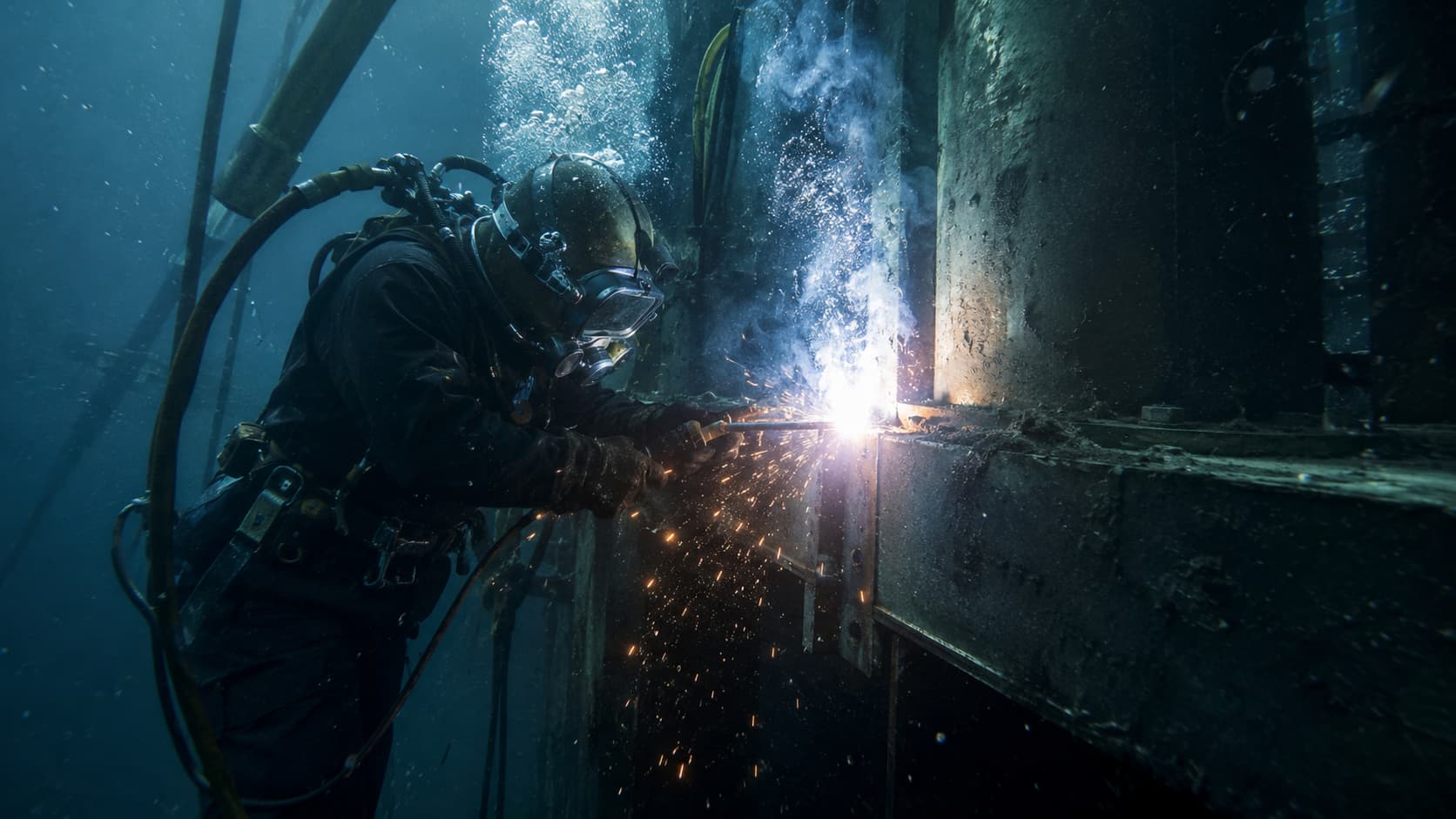
Electricity and water are two things most people would never want to put together.
Underwater welders do exactly that for a living.
They descend below the surface to repair ships, pipelines, offshore structures, bridges, dams, and other metal structures that cannot simply be brought onto dry land.
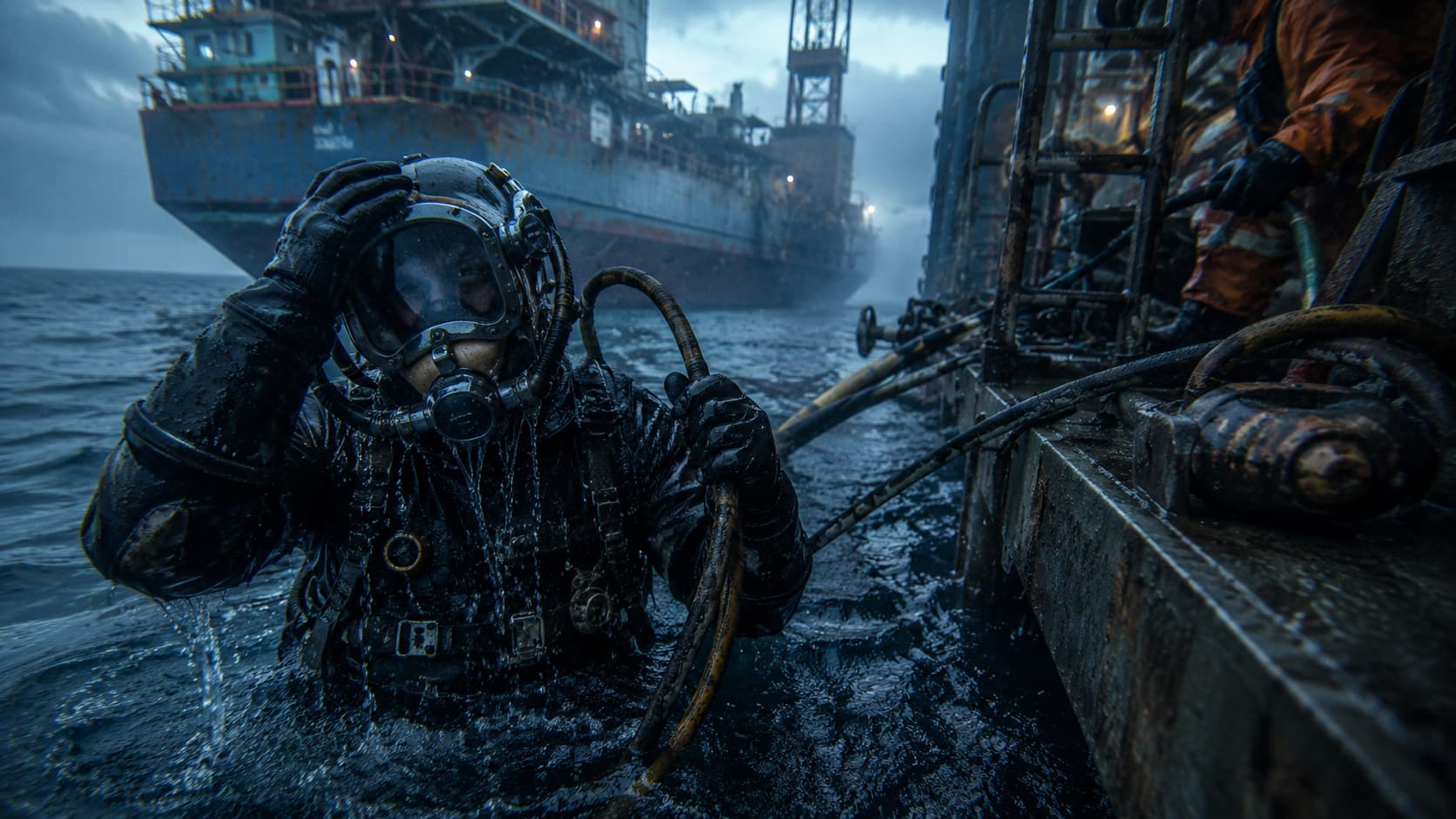
The work can take place in dark water with limited visibility, heavy equipment, strong currents, cold temperatures, and significant pressure.
That makes underwater welding one of those occupations that looks almost unbelievable when seen in a short video.
But how does it actually work? How much can an underwater welder earn in the United States? And what kind of training does someone need before being allowed to perform this type of work?
What Does an Underwater Welder Actually Do?
“Underwater welder” is not usually a completely separate occupation from commercial diving.
In the United States, underwater welding is generally one of many tasks that a commercial diver may perform.
O*NET describes commercial divers as workers who perform underwater tasks using surface-supplied air or scuba equipment. Their duties can include inspecting structures, repairing equipment, installing components, cutting steel, and welding underwater. (O*NET OnLine)
That means an underwater welder may spend only part of a job actually welding.
On another day, the same diver might be:
- inspecting a damaged structure;
- cutting steel;
- repairing pipes or valves;
- taking underwater photographs;
- testing a structure for cracks;
- installing supports;
- recovering equipment;
- cleaning marine growth;
- assisting with salvage work.
O*NET specifically lists cutting and welding steel with underwater welding equipment among the core tasks performed by commercial divers. (O*NET OnLine)
So the occupation is better understood as:
commercial diver first, underwater tradesperson second.
Where Do Underwater Welders Work?
Their workplace depends on the project.
Commercial divers may work around:
- ships;
- ports;
- docks;
- bridges;
- dams;
- pipelines;
- offshore oil and gas structures;
- industrial facilities;
- underwater construction sites.
Some jobs are performed close to shore.
Others may require workers to travel offshore and remain away from home for extended periods.
O*NET lists construction and administrative/support services among the major industries employing commercial divers. (O*NET OnLine)
The specific environment can change dramatically from one assignment to another.
One project might involve repairing a ship in a harbor.
Another might involve inspecting structural components beneath an offshore platform.
How Does Welding Underwater Actually Work?
There are two broad approaches to underwater welding.
Wet Welding
With wet welding, the diver performs the weld directly in the surrounding water.
The electrode and welding equipment are designed for underwater work.
The electric arc generates enough heat to melt the metal despite the surrounding water.
Gas produced around the arc temporarily creates a small protective area where the weld forms.
The diver still has to work while dealing with water movement, limited visibility, bulky equipment, and an environment very different from a normal welding shop.
Dry or Hyperbaric Welding
Some underwater welding is performed inside a sealed chamber placed around the work area.
Water is removed from the chamber and the pressure inside is controlled.
The welder can then work in a dry environment even though the repair site remains below the waterline.
This approach can produce different working conditions and may be selected for certain critical repairs.
The method used depends on the structure, depth, project requirements, and engineering specifications.
How Much Do Underwater Welders Make in the U.S.?
This is where many viral claims become misleading.
You may see videos suggesting that underwater welders routinely earn:
$100,000, $200,000, or even $300,000 per year.
Those numbers should not be treated as normal salaries.
The federal government does not publish a separate wage category specifically called “underwater welder.”
Instead, underwater welding is included within the broader occupation of commercial divers.
O*NET currently reports a 2025 median wage of $35.09 per hour, or $72,990 per year, for commercial divers in the United States. (O*NET OnLine)
It also reports approximately 4,200 employees in 2024 and projects employment growth of 7% or higher from 2024 through 2034. (O*NET OnLine)
These numbers provide a much better benchmark than extreme salary claims on social media.
However, they still do not tell us exactly what every underwater welder earns.
Can Underwater Welders Earn More Than $72,990?
Yes.
The median is only the middle of the wage distribution.
Older BLS occupational wage data illustrates how wide commercial-diving pay can be. In May 2023, BLS reported a median annual wage of $61,300 for commercial divers, while the 90th percentile reached approximately $136,990 per year. (Bureau of Labor Statistics)
More recent O*NET data places the median higher, at $72,990 for 2025. (O*NET OnLine)
Actual earnings can differ based on:
- experience;
- location;
- employer;
- offshore versus inland work;
- depth;
- specialized skills;
- project duration;
- overtime;
- travel;
- hazard exposure;
- union arrangements;
- supervisory responsibility.
A highly experienced diver working difficult offshore projects may therefore earn substantially more than someone entering the occupation.
But the highest-paid workers should not be presented as typical.
Why Do Some Underwater Welders Report Six-Figure Incomes?
Several factors can push annual earnings upward.
Offshore Assignments
Some offshore jobs involve demanding schedules, travel, long periods away from home, and difficult environmental conditions.
Overtime
Commercial-diving projects may operate on schedules that create substantial overtime during busy periods.
Specialized Skills
A diver who can weld, inspect, cut, rig, repair equipment, and perform other industrial tasks may be more valuable than someone with a narrower skill set.
Experience
Employers are unlikely to assign the most difficult underwater repairs to an inexperienced diver.
Experienced workers who can perform specialized work safely may command higher compensation.
Project-Based Work
Some divers do not work a simple 9-to-5 schedule for 52 identical weeks each year.
They may move from project to project, with periods of intense work followed by slower periods.
That makes annual earnings less predictable than in many conventional occupations.
Is $100,000 a Year Realistic?
It can be possible for some commercial divers.
It should not be treated as automatic.
The older BLS data showing a 90th-percentile wage above $136,000 confirms that high compensation exists within commercial diving. (Bureau of Labor Statistics)
But a person beginning underwater welding should not assume that completing training immediately produces a six-figure salary.
Entry-level workers still need to build experience and prove they can perform safely under demanding conditions.
What Does a Typical Workday Look Like?
A day may begin long before the diver enters the water.
The crew first prepares the site and checks equipment.
That can include:
- helmet or diving mask;
- breathing system;
- communications equipment;
- hoses;
- cables;
- welding equipment;
- protective clothing;
- tools;
- emergency equipment.
The surface team also plays a major role.
Commercial diving is not usually a lone worker disappearing underwater with a welding machine.
Workers above the surface may monitor the diver, manage equipment, maintain communications, and respond if something goes wrong.
Once the diver reaches the work area, visibility may be limited.
The structure might be covered in rust, marine growth, mud, or debris.
The diver may first need to inspect or clean the surface before any welding begins.
Only then can the actual repair work start.
Afterward, the weld or repair may need to be inspected before the diver returns to the surface.
Why Is Visibility Such a Problem?
Water in real industrial environments is often nothing like the clear water shown in recreational diving videos.
A commercial diver may work around:
- mud;
- sediment;
- marine growth;
- industrial structures;
- moving water;
- darkness;
- suspended particles.
In some environments, the diver may barely be able to see the work directly in front of the helmet.
That means touch, experience, communication, lighting, and careful positioning can become extremely important.
Is Underwater Welding Really One of the Most Dangerous Jobs?
Commercial diving contains serious hazards.
OSHA identifies underwater cutting and welding as one of several work activities that can expose commercial divers to significant risks. Other hazards may come from material handling, hull cleaning, tools, construction activities, and the diving environment itself. (Cơ Quan An Toàn và Sức Khỏe Nghề Nghiệp)
The danger does not come from a single factor.
It comes from several hazards occurring at the same time.
What Are the Biggest Risks?
Diving-Related Pressure Hazards
As a diver descends, surrounding pressure increases.
Commercial diving therefore requires careful management of depth, breathing gases, ascent procedures, and decompression.
Breathing-System Problems
A diver depends on a reliable breathing supply.
Problems involving breathing equipment or gas delivery can quickly become serious underwater.
Entanglement
Cables, ropes, hoses, debris, structural components, and other objects may create entanglement hazards.
Poor Visibility
A diver may have difficulty seeing hazards nearby.
Current and Water Movement
Moving water can make it harder to maintain position while performing precision work.
Electrical Hazards
Underwater welding involves electrical equipment in a wet environment.
The systems and procedures are specifically designed for this type of work, but electrical hazards still have to be controlled.
Burns and Welding Hazards
The welding arc produces intense heat.
The worker still faces hazards associated with welding even though the job is taking place underwater.
Heavy Structures and Tools
Commercial divers often work around large metal structures, tools, pipes, equipment, and machinery.
OSHA notes that commercial diving can involve construction-type hazards in combination with diving hazards. (Cơ Quan An Toàn và Sức Khỏe Nghề Nghiệp)
Can Underwater Welders Get Decompression Sickness?
Decompression illness is one of the risks associated with diving.
When a diver works under increased pressure, gases can dissolve into body tissues.
Ascending too rapidly or failing to follow the required decompression procedure can lead to serious medical consequences.
That is one reason commercial diving operations depend on formal procedures rather than simply sending a worker underwater and bringing them back whenever the task is complete.
Depth and time underwater can directly affect how the dive must be managed.
Do Underwater Welders Really Work Hundreds of Feet Below the Surface?
Some commercial diving jobs can involve significant depth, but not every underwater welder performs deep offshore work.
Many jobs occur at much shallower depths around:
- bridges;
- docks;
- ships;
- harbor structures;
- inland industrial facilities.
The dramatic deep-water assignments seen online represent only part of the occupation.
Depth also changes the equipment, procedures, training, and risk involved.
What Training Do You Need?
Someone cannot simply become a recreational scuba diver, buy welding equipment, and begin doing professional underwater repairs.
The American Welding Society describes underwater welding as a career path involving commercial diving training combined with welding skills. AWS recommends attending an accredited commercial diving program and building practical underwater welding experience. (American Welding Society)
Its career profile lists a high school diploma or equivalent as the minimum educational level and commercial-diving certification as minimum training, while recommending education in areas such as welding or metal fabrication. (American Welding Society)
AWS also notes that many underwater welders begin with welding experience before moving into commercial diving and specialized underwater training. (American Welding Society)
A typical path may therefore look like:
Learn welding → complete commercial-diviving training → learn underwater work techniques → gain field experience.
The precise requirements depend on the employer and project.
Do You Need a College Degree?
Usually not a traditional four-year degree.
AWS lists a high school diploma or equivalent as the minimum educational level in its underwater-welder career profile. (American Welding Society)
The important education is more occupational:
- welding;
- commercial diving;
- safety;
- rigging;
- inspection;
- underwater tools;
- emergency procedures.
This is a skilled trade rather than a typical college-office career.
Is Recreational Scuba Certification Enough?
No.
Recreational scuba focuses on a very different activity.
Commercial divers work while underwater.
They may handle tools, heavy equipment, industrial structures, welding systems, construction tasks, and specialized breathing equipment.
That requires training beyond what is expected of a recreational diver.
AWS specifically points aspiring underwater welders toward commercial-diving programs rather than recreational scuba training alone. (American Welding Society)
Is Underwater Welding the Only Skill You Need?
No.
This may be one of the biggest misconceptions about the occupation.
A company does not simply need someone who can make a weld underwater.
It may need a diver who can:
- inspect;
- cut;
- rig;
- repair;
- photograph;
- measure;
- operate tools;
- communicate with the surface;
- understand industrial structures.
O*NET’s task list reflects this variety. Commercial divers may inspect structures, repair pipes and valves, perform non-destructive testing, recover objects, install supports, and perform welding and cutting. (O*NET OnLine)
The broader the worker’s skills, the more types of projects may be available.
How Many Underwater Welders Are There in America?
There is no exact federal count specifically for underwater welders because they are counted within commercial diving.
O*NET reports approximately 4,200 commercial-diving employees in the United States in 2024. (O*NET OnLine)
That alone shows how small the occupation is compared with major American job categories.
It is a specialized field.
Is Demand Growing?
O*NET currently classifies commercial-diver employment growth for 2024–2034 as much faster than average, at 7% or higher, with approximately 400 projected job openings over that period. (O*NET OnLine)
Because the total occupation is small, even modest changes can produce a relatively high percentage growth rate.
It should therefore not be interpreted as a mass-hiring industry.
Is Underwater Welding Worth It?
For the right person, it can be an unusual skilled career.
Someone attracted to the occupation may like:
- physical work;
- diving;
- welding;
- travel;
- industrial projects;
- working outside an office;
- solving mechanical problems.
But the tradeoffs are substantial.
The work can involve:
- difficult physical conditions;
- travel;
- long periods away from home;
- unpredictable schedules;
- cold or dark water;
- industrial hazards;
- extensive safety procedures.
And although highly paid positions certainly exist, the available federal data does not support the idea that every underwater welder automatically becomes rich.
So How Much Are They Really Paid to Weld Underwater?
There is no single number.
The best current federal benchmark is the broader commercial-diver occupation, with O*NET reporting median 2025 earnings of about $72,990 per year, or $35.09 per hour. (O*NET OnLine)
Experienced workers in demanding or specialized positions may earn much more.
New divers may earn less.
The gap between those two groups can be large.
And that is what makes the job so interesting.
From the surface, an underwater welder may look like someone simply diving down with a welding torch.
In reality, the worker is combining two skilled trades while dealing with an environment where pressure, visibility, equipment, breathing supply, and safety procedures all matter.
Most people would never want to mix electricity, deep water, heavy steel, and darkness.
For an underwater welder…
that can be a normal day at work.
