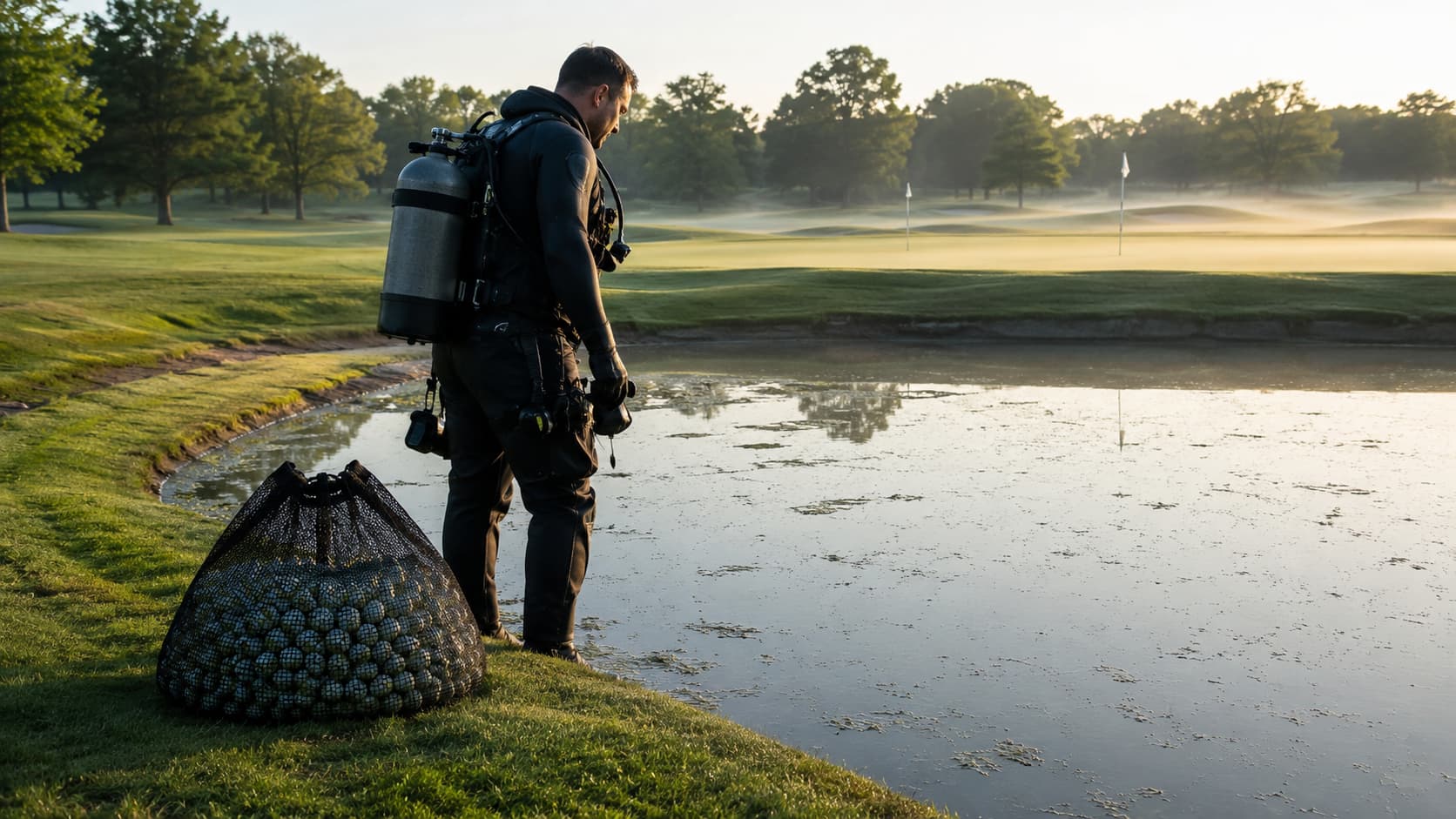
Every year, golfers send countless balls into ponds, lakes, and water hazards across America.
Most players simply leave them behind.
But for a small group of workers, those lost golf balls are worth going underwater for.
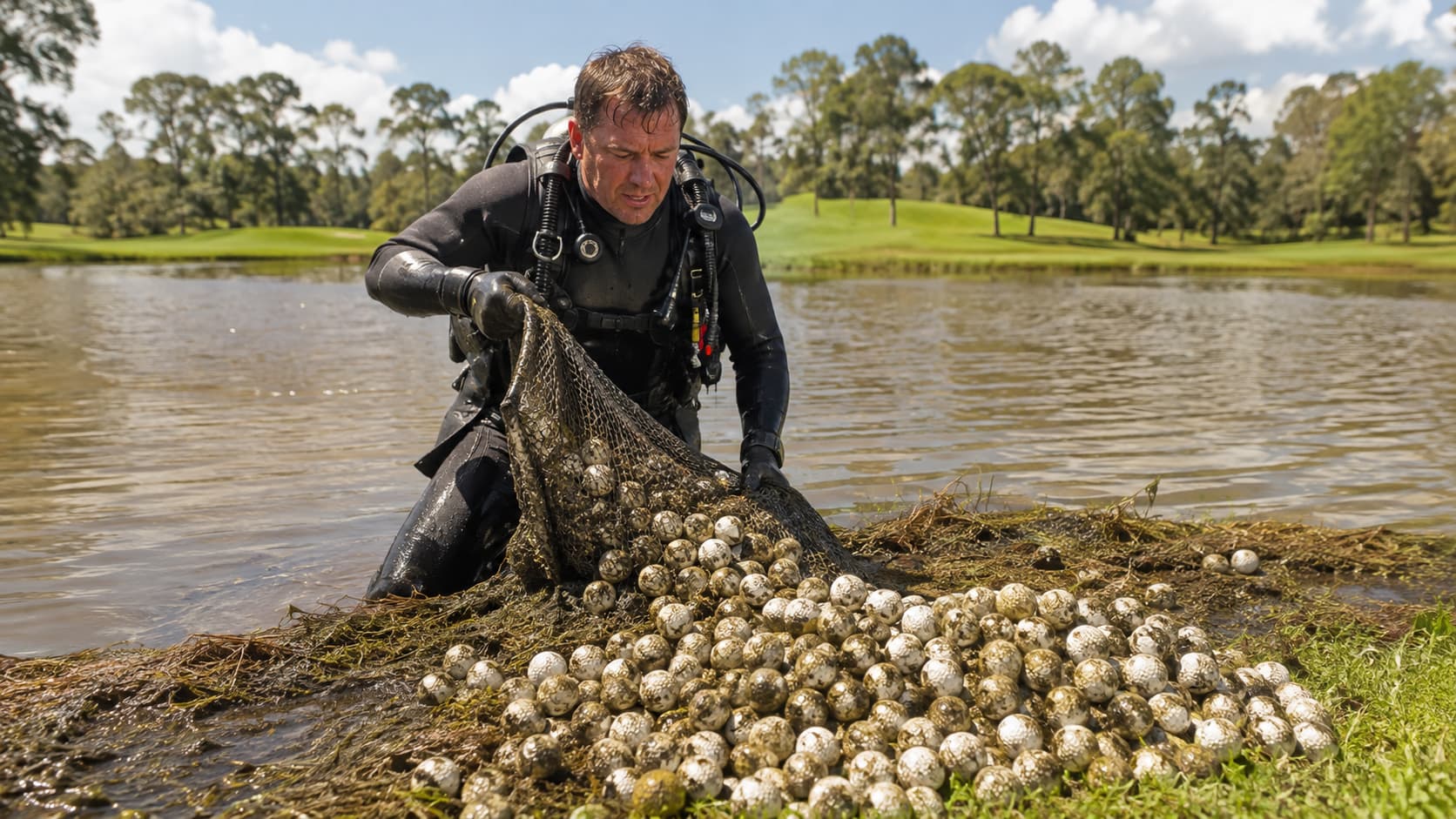
Golf ball divers enter murky ponds, collect hundreds or sometimes thousands of balls, bring them back to the surface, and help return usable balls to the resale market.
It sounds like an unusual side job. In reality, it can involve scuba equipment, physical labor, commercial agreements with golf courses, difficult underwater conditions, and real safety risks.
So what does a golf ball diver actually do, who pays them, and how much money can someone really make?
WHAT DOES A GOLF BALL DIVER ACTUALLY DO?
The basic idea is simple.
Golf courses lose large numbers of balls in water hazards. Instead of leaving them at the bottom permanently, some courses allow professional divers or recovery companies to collect them.
A diver may enter a pond wearing scuba or surface-supplied diving equipment and search the bottom by hand.
Visibility can be extremely poor.
Rather than swimming around looking for individual white balls, divers may spend much of the job feeling through mud, weeds, branches, and debris.
Recovered balls are placed into bags or containers and taken back to shore.
The balls can then be:
- cleaned;
- sorted by brand and condition;
- sold back to golf courses;
- sold to used-ball retailers;
- supplied to companies that process and resell recovered golf balls.
The work is less like searching for treasure and more like performing repetitive physical labor underwater.
HOW MANY GOLF BALLS CAN A DIVER FIND?
The number varies greatly by golf course, pond, season, and how frequently the water has previously been searched.
A heavily played course can accumulate a large number of balls.
The U.S. Bureau of Labor Statistics previously profiled golf ball diving as an unusual occupation and noted that divers commonly earn money based on the balls they recover rather than receiving a standard salary from the golf course.
An older account published by Scuba Diving described one diver recovering about 1,400 balls during roughly an hour underwater from a particular pond. That example should not be treated as a normal hourly production rate for every diver, but it shows how concentrated lost golf balls can become in some water hazards.
A productive pond can therefore contain thousands of recoverable balls.
But finding them is only the beginning.
The balls still need to be hauled out of the water, transported, cleaned, graded, and sold.
HOW DO GOLF BALL DIVERS GET PAID?
This is where the job becomes especially interesting.
There is no single nationwide pay system for golf ball divers.
Some operate as independent contractors and negotiate access to golf courses. Depending on the agreement, the course might receive:
- a payment for each recovered ball;
- a percentage of the recovered inventory;
- some of the cleaned balls;
- another negotiated fee.
The diver or recovery company then earns money by selling the remaining balls.
The Bureau of Labor Statistics has reported anecdotal earnings of roughly $200 per day for golf ball divers, while stressing that independent contractors must cover expenses such as taxes, insurance, benefits, and retirement savings themselves.
That figure comes from an older BLS occupational profile, so it should not be treated as a current nationwide salary.
This is one reason claims such as “every golf ball diver makes $100,000 a year” should be treated cautiously.
Some successful operators may earn far more than others.
For example, CBS 8 San Diego profiled a professional golf ball diver who reportedly generated about $100,000 per year from the work. That is an individual example, not a standard salary for the occupation.
SO HOW MUCH CAN A GOLF BALL DIVER MAKE IN 2026?
There is a problem when trying to answer this question with one number:
Golf ball diver is not tracked by the federal government as its own large occupational category.
A useful comparison is the broader category of commercial divers.
O*NET, using 2025 Bureau of Labor Statistics wage data, reports median pay for U.S. commercial divers at approximately:
$35.09 per hour
or
$72,990 per year.
O*NET also reports about 4,200 commercial-diving employees in 2024, with projected growth of 7% or higher through 2034.
But this does not mean the typical golf ball diver earns $72,990.
Commercial diving includes many forms of underwater work, such as inspection, construction, repair, maintenance, salvage, and other industrial activities.
Golf ball recovery is only a small specialty within the broader world of professional diving.
Actual golf-ball-diving income can depend heavily on:
- how many golf courses the diver services;
- how many balls are recovered;
- resale prices;
- contracts with course owners;
- equipment costs;
- transportation;
- diving experience;
- local competition;
- weather and seasonality.
For some people, it may function more like a small business than a normal salaried job.
WHAT DOES A TYPICAL DAY LOOK LIKE?
A golf ball diver may begin early, often arranging work when golfers are less likely to be near the pond.
Before entering the water, the diver checks equipment and evaluates the site.
Once underwater, the job can become surprisingly uncomfortable.
Golf course ponds are rarely clear swimming pools.
The diver may encounter:
- thick mud;
- weeds;
- tree branches;
- discarded fishing line;
- submerged objects;
- very low visibility;
- cold water;
- steep pond bottoms.
Recovered golf balls can become heavy quickly.
One historical account described bags containing roughly 700 golf balls weighing around 70 pounds each.
After leaving the water, the job still is not finished.
The recovered balls may need to be transported, washed, inspected, sorted, stored, and prepared for resale.
A diver running an independent operation may also spend time contacting golf courses, arranging contracts, maintaining equipment, finding buyers, keeping records, and handling business expenses.
IS GOLF BALL DIVING DANGEROUS?
Yes.
The job may look amusing in a short social-media video, but diving into dark ponds creates genuine hazards.
Poor visibility makes it difficult to see underwater obstacles.
Divers may become caught in weeds, ropes, fishing line, branches, or other debris.
They also have to manage the normal risks associated with diving equipment and underwater work.
In some parts of the United States, wildlife can create another concern.
Golf courses in states such as Florida may have ponds inhabited by alligators or other animals.
Professional divers therefore need to assess each location rather than treating every golf-course pond as a harmless body of water.
This is not simply a matter of putting on goggles and jumping in.
DO YOU NEED SCUBA TRAINING?
Someone planning to perform paid underwater work should take training, equipment requirements, insurance, local rules, and employer or contractor requirements seriously.
Commercial-diving work can involve formal training and safety procedures that go beyond recreational scuba diving.
O*NET describes commercial divers as workers who perform tasks underwater while using diving equipment and lists specialized training and preparation as part of the occupation.
Requirements can vary considerably depending on the employer, location, type of diving, and nature of the contract.
Anyone considering this work should determine the exact rules applying to the specific job rather than assuming a recreational scuba card is enough.
WHERE DOES THE MONEY COME FROM?
The economics of golf ball recovery are based on something golfers already know:
Golf balls are not free.
Many recovered balls remain usable.
After cleaning and grading, they can be sold as used or recycled golf balls for less than the cost of new premium balls.
That creates a chain:
Golfer loses ball → diver recovers ball → ball is cleaned and graded → buyer purchases used ball → ball returns to the course.
A single ball is worth relatively little.
Thousands of balls are another matter.
That volume is what can turn underwater recovery into a business.
CAN YOU MAKE A FULL-TIME LIVING AS A GOLF BALL DIVER?
Possibly, but the answer depends heavily on how the business is structured.
A diver with contracts covering many busy golf courses, efficient recovery methods, reliable buyers, and strong resale margins may have a very different income from someone who occasionally cleans a few local ponds.
Independent contractors also have costs that salaried employees do not always pay directly.
Those can include:
- scuba and diving equipment;
- equipment maintenance;
- fuel;
- vehicle costs;
- insurance;
- taxes;
- storage;
- cleaning equipment;
- travel;
- safety gear.
So revenue is not the same thing as personal income.
Stories about unusually successful divers are interesting, but they should not be interpreted as guarantees.
WOULD THIS JOB BE RIGHT FOR MOST PEOPLE?
Probably not.
Someone interested in golf ball diving would need to be comfortable working underwater in conditions that may be dark, muddy, cold, physically demanding, and unpleasant.
The job can make more sense for someone who already has professional diving skills and understands how to build relationships with golf courses and buyers.
But that is also what makes the occupation fascinating.
Most golfers see a ball disappear into a pond and assume its story is over.
For a golf ball diver, that is where the work begins.
Thousands of forgotten golf balls can sit beneath a single course, and someone has to go down into the mud to bring them back.
For the right person, those lost balls are not garbage.
They are inventory.
