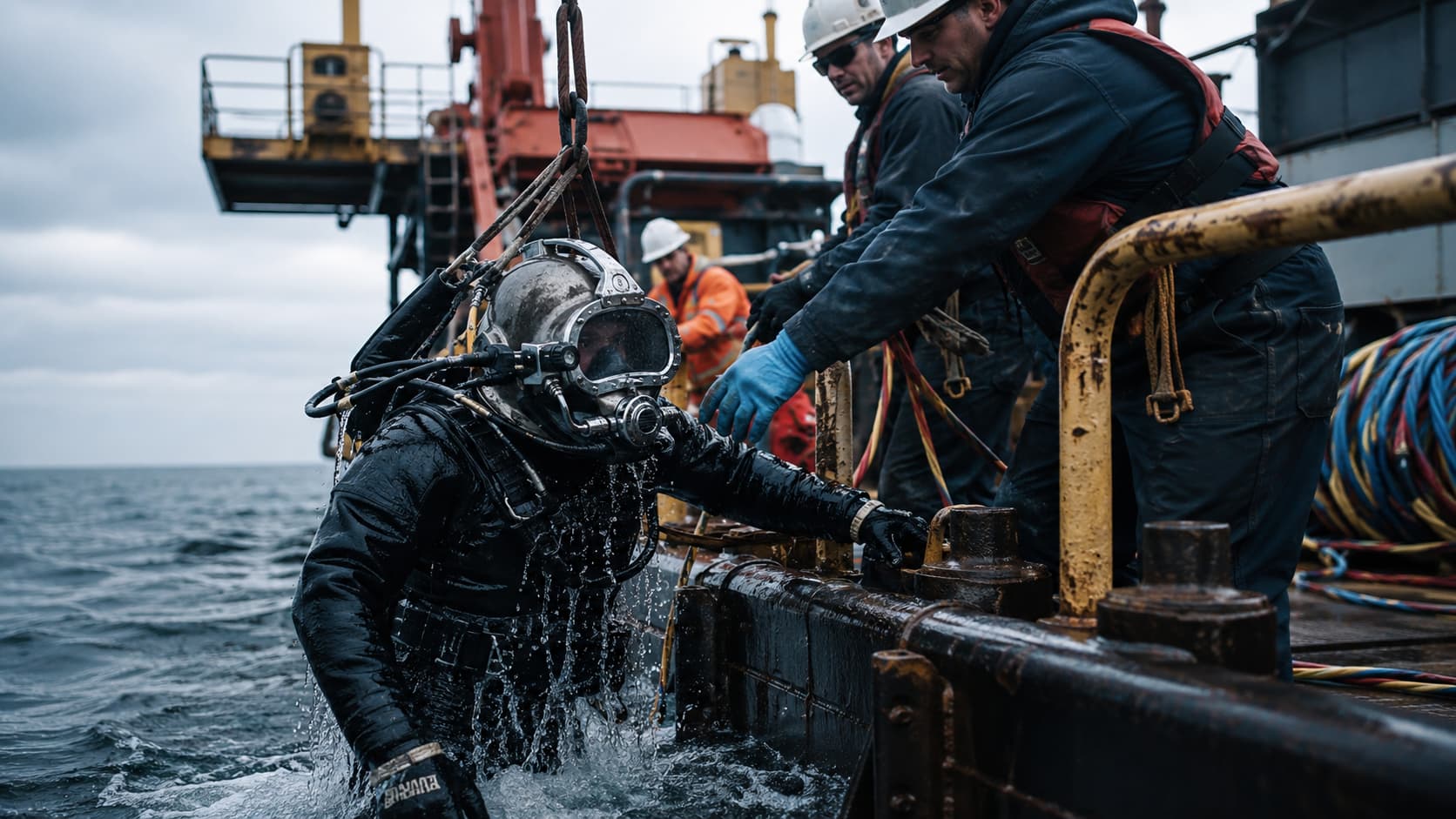
Most jobs happen somewhere people can easily see.
Commercial divers often work in places almost no one ever will.
They descend beneath docks, bridges, ships, dams, offshore structures, and industrial facilities to inspect, repair, cut, install, and recover equipment below the surface.
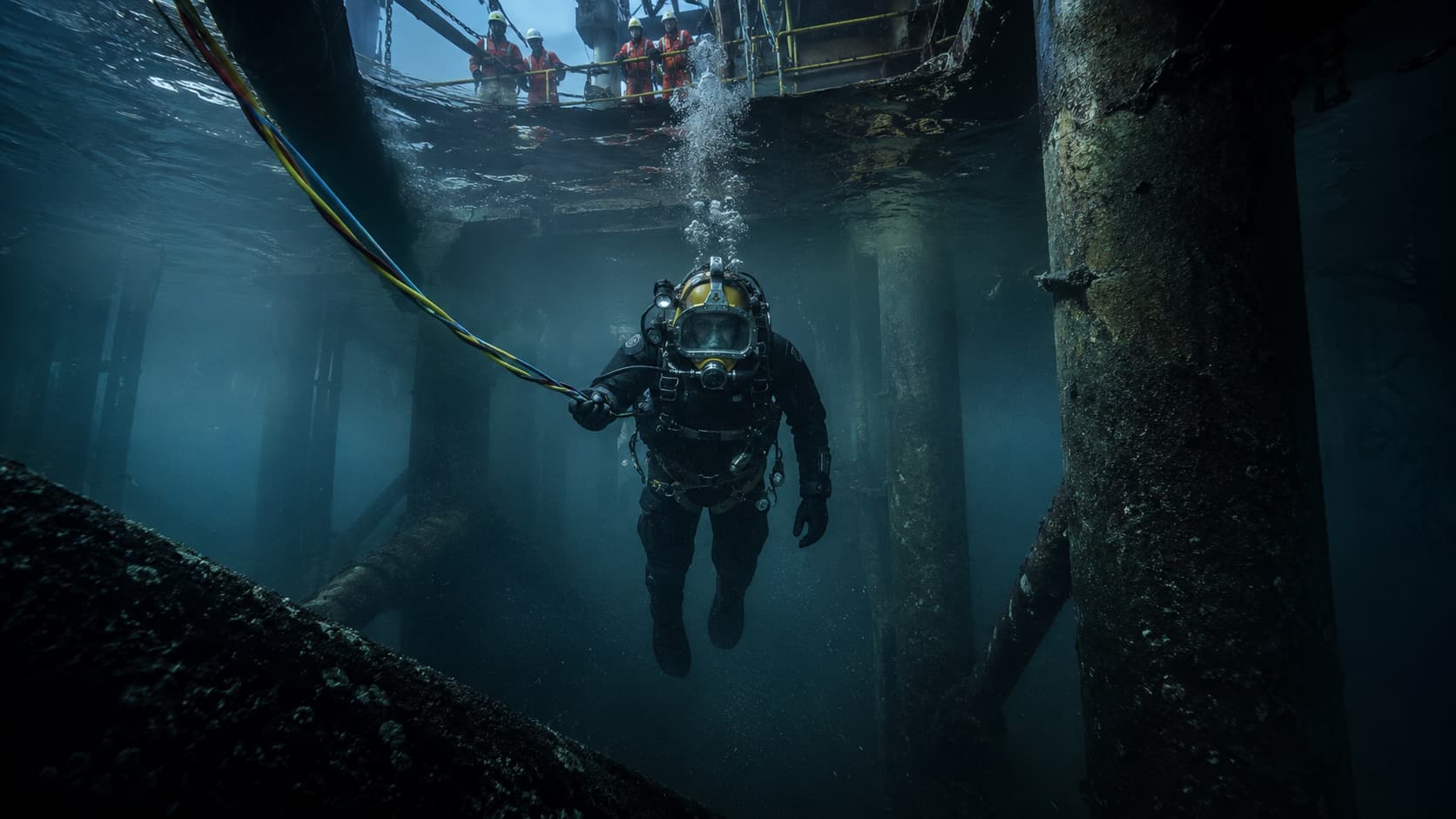
The environment can be dark.
Visibility may be only a few feet — or less.
The water can be cold, currents can move unexpectedly, and the diver may depend on breathing equipment and communication lines connecting them to a team above.
It looks like extreme diving.
But commercial diving is not recreation.
It is skilled industrial work performed underwater.
So what do commercial divers actually do, how much can they earn in the United States, what training is required, and why can this career become so dangerous?
What Does a Commercial Diver Actually Do?
Commercial divers perform paid underwater work rather than diving for recreation.
O*NET describes commercial divers as workers who perform underwater tasks using surface-supplied air or scuba equipment. Their duties may include inspecting structures, repairing equipment, installing components, cutting and welding steel, taking photographs, recovering objects, and performing other industrial tasks.
That means there is no single “normal” commercial-diving job.
One assignment might involve inspecting the underside of a bridge.
Another might require repairing equipment beneath a ship.
A different project could involve recovering machinery that fell into the water.
Common tasks can include:
- inspecting underwater structures;
- measuring damage;
- repairing pipes and valves;
- installing equipment;
- cutting metal;
- underwater welding;
- recovering lost objects;
- cleaning hulls;
- performing underwater photography;
- conducting tests;
- assisting with construction;
- supporting salvage operations.
This variety is one reason the occupation requires more than simply being a strong swimmer.
Where Do Commercial Divers Work?
Commercial divers can work in many environments.
Possible workplaces include:
- ports;
- harbors;
- offshore facilities;
- bridges;
- dams;
- rivers;
- industrial sites;
- ships;
- underwater construction projects.
O*NET lists construction and administrative/support services among the major industries employing commercial divers.
Some divers may stay relatively close to shore.
Others may travel to remote projects or spend extended periods working from vessels or offshore facilities.
The location can significantly change the nature of the job.
Repairing a dock in relatively shallow water is very different from working offshore in deeper water with complex industrial equipment.
How Much Do Commercial Divers Make in the U.S.?
Commercial diving can pay well, but the numbers vary widely.
Current O*NET data based on 2025 Bureau of Labor Statistics wage information reports a national median wage of:
$35.09 per hour
or approximately:
$72,990 per year.
That is a useful benchmark because it comes from federal occupational wage data.
But it does not mean every commercial diver earns about $73,000.
The wage range is broad.
Current O*NET wage data shows that nationally:
- the lowest 10% earned about $43,330 or less;
- the median was about $72,990;
- the highest 10% earned about $157,790 or more.
That difference is enormous.
It also explains why online claims about commercial-diver salaries can sound contradictory.
Some workers really can earn six figures.
Others earn much less.
Can Commercial Divers Really Make More Than $100,000?
Yes.
Federal wage data supports that possibility.
The national 90th-percentile figure is above $150,000 in the current O*NET/BLS data.
But a new diver should not assume that completing school immediately leads to that income.
Higher earnings may be associated with factors such as:
- experience;
- difficult projects;
- specialized skills;
- offshore assignments;
- depth;
- overtime;
- travel;
- supervisory responsibility;
- location;
- employer;
- type of diving performed.
A highly experienced diver working demanding industrial assignments may have a very different income from someone doing entry-level inland work.
Why Does the Pay Vary So Much?
Commercial diving is a broad occupation.
Two people with the same general job title may perform very different work.
For example, one diver might inspect relatively shallow infrastructure during regular daytime shifts.
Another might work on a remote offshore project requiring long hours, travel, difficult environmental conditions, and specialized technical skills.
Compensation can reflect those differences.
There is also another issue:
BLS wage data covers wage and salary workers and does not include every self-employed worker or business owner.
So individual contractor income may not match the federal wage distribution.
What Does a Typical Commercial Dive Look Like?
A professional dive begins long before the diver enters the water.
The team first has to understand the assignment and assess the site.
OSHA requires commercial-diving operations to address pre-dive procedures, diver qualifications, equipment, safe practices, emergency planning, and procedures during and after the dive.
Before entering the water, the team may review:
- depth;
- water temperature;
- weather;
- current;
- visibility;
- breathing-gas requirements;
- work being performed nearby;
- decompression requirements;
- emergency procedures.
OSHA specifically requires a pre-dive briefing covering hazards, procedures, equipment, and emergency issues.
The diver then prepares specialized equipment.
Depending on the operation, that can include:
- helmet or mask;
- breathing-gas hose;
- communications cable;
- protective suit;
- harness;
- tools;
- lights;
- cutting or welding equipment;
- measurement instruments.
Only after the site and equipment are prepared does the diver descend.
Why Are There So Many Cables Attached to the Diver?
In industrial footage, commercial divers often appear connected to the surface by several lines.
One of the most important systems may provide breathing gas from above.
Another may provide communication.
Other components can support equipment or safety functions.
Surface-supplied air diving is specifically covered by OSHA commercial-diving regulations.
This arrangement allows surface personnel to remain in contact with the diver and monitor the operation.
That is very different from recreational scuba, where a diver commonly carries the breathing supply on their back.
Do Commercial Divers Ever Use Scuba?
Yes, commercial-diving regulations include scuba operations as well as surface-supplied air and mixed-gas diving.
But the equipment used depends on the task and environment.
Many industrial operations favor surface-supplied systems because they provide continuous communication and breathing-gas support from the surface.
Commercial diving should therefore not be imagined as someone simply putting on a recreational scuba tank and taking power tools underwater.
Why Is the Surface Crew So Important?
The diver is only one member of the operation.
Your video correctly emphasizes this point.
Commercial divers do not normally perform demanding industrial work completely alone.
OSHA’s rules address the qualifications of the dive team and require defined procedures for commercial-diving operations.
The surface team may help:
- manage breathing-gas systems;
- monitor communications;
- handle lines;
- track dive time;
- manage equipment;
- coordinate the work;
- prepare for emergencies.
That support becomes critical when the diver is underwater in conditions where quickly returning to the surface may not always be possible.
How Bad Can Visibility Get?
Very bad.
Commercial diving often occurs in water that bears little resemblance to tropical scuba footage.
OSHA identifies low visibility as one of the occupational hazards commercial divers may face.
Mud, sediment, darkness, industrial debris, and water movement can make it difficult to see even nearby objects.
In some environments, the diver may need to rely heavily on:
- touch;
- lighting;
- tools;
- communication;
- knowledge of the structure;
- instructions from the surface team.
A simple inspection can become much harder when the worker can barely see the object being inspected.
What Happens as the Diver Goes Deeper?
Pressure increases with depth.
That affects both the diver and the diving operation.
Commercial-diving teams have to account for issues such as:
- breathing gas;
- dive duration;
- decompression;
- ascent procedures;
- physiological effects of pressure.
OSHA has specific requirements for deeper dives and dives that exceed no-decompression limits. For certain dives deeper than 100 feet of seawater or involving mixed gas, the employer must keep the diver near a decompression chamber for at least an hour after the dive.
That gives some sense of how different deeper commercial work can be from ordinary recreational diving.
Is Commercial Diving Dangerous?
Yes.
OSHA states that commercial divers can face not only drowning risk but also respiratory and circulatory hazards, hypothermia, low visibility, and physical injury from heavy equipment underwater.
The difficulty comes from the combination of hazards.
A diver may be:
- underwater;
- exposed to pressure;
- working in cold conditions;
- handling tools;
- near heavy equipment;
- dealing with poor visibility;
- dependent on breathing equipment.
A problem that would be inconvenient on land can become much more serious underwater.
What Are the Biggest Risks?
Drowning
Any failure involving breathing systems, entrapment, equipment, or the diver’s ability to return safely can become life-threatening.
Pressure-Related Problems
Depth changes the physical environment around the diver.
Incorrect ascent or decompression procedures can cause serious medical problems.
Hypothermia
Cold water can rapidly remove heat from the body.
OSHA specifically identifies hypothermia as a commercial-diving hazard.
Poor Visibility
A diver may not clearly see nearby equipment, structural hazards, cables, or other objects.
Heavy Equipment
Industrial divers may work around machinery, tools, vessels, steel structures, and moving equipment.
OSHA notes physical injury from heavy equipment as one of the occupation’s hazards.
Entanglement
Hoses, cables, ropes, fishing line, structural components, and debris can create entanglement risks.
Current
Strong water movement can make positioning difficult and interfere with work.
Breathing-Gas Problems
The diver’s breathing system has to function reliably throughout the operation.
Can Commercial Divers Get Decompression Sickness?
Yes.
Decompression illness is one of the major concerns associated with diving under pressure.
OSHA commercial-diving rules include requirements for decompression procedures and recompression capability for certain dives.
The risk depends on variables such as:
- depth;
- time underwater;
- breathing mixture;
- ascent profile.
This is why commercial dives are planned rather than treated as a worker simply going down until the job is finished.
What Kind of Work Can They Perform Underwater?
The range can surprise people.
O*NET lists tasks including:
- inspecting structures;
- repairing equipment;
- recovering objects;
- taking photographs;
- installing equipment;
- cutting steel;
- welding underwater.
This means many commercial divers develop technical abilities beyond diving itself.
A diver might also know:
- rigging;
- welding;
- cutting;
- inspection;
- mechanical repair;
- underwater construction.
Being good at diving is only part of the career.
Is Commercial Diving the Same as Underwater Welding?
No.
Underwater welding is a specialized task that some commercial divers perform.
BLS’s occupational classification explicitly places the direct title Underwater Welder under Commercial Divers.
But not every commercial diver is primarily an underwater welder.
A diver may spend much more time performing inspection, repair, installation, cleaning, salvage, or other underwater work.
This distinction is useful because social-media videos often treat “commercial diver” and “underwater welder” as if they were identical jobs.
They are not.
What Training Do You Need?
Commercial diving requires specialized training.
The Association of Diving Contractors International states that applicants for its commercial-diver certification program must provide evidence of formal commercial-diver training, and its minimum qualification currently calls for at least 625 documented hours of instruction covering required subjects.
ADCI also states that personnel working for its general-member companies need current certification appropriate to the tasks they perform.
Training may cover subjects such as:
- diving physics;
- diving medicine;
- surface-supplied equipment;
- underwater tools;
- decompression;
- communications;
- rigging;
- emergency procedures;
- inspection;
- industrial safety.
Training standards and employer requirements can differ, so prospective divers need to check the qualifications required for the specific jobs they want.
Can You Become a Commercial Diver With Only a Recreational Scuba Card?
For serious professional work, that is generally not the right pathway.
Commercial diving involves occupational work, industrial equipment, formal dive teams, emergency planning, and workplace safety requirements that differ from recreational diving.
OSHA maintains an entire regulatory subpart specifically for commercial-diving operations, including qualifications, equipment, pre-dive procedures, post-dive procedures, surface-supplied air, mixed-gas diving, and other requirements.
Someone considering this career should look for recognized commercial-diving training rather than assuming ordinary recreational certification is enough.
Do You Need a College Degree?
A traditional four-year degree is not usually the defining credential.
Commercial-diving training and technical competence matter far more.
O*NET places Commercial Divers in Job Zone Three, which generally indicates medium preparation involving vocational training, related experience, or education rather than a typical four-year academic path.
Workers also continue building skill through field experience.
The industry is very practical.
Employers need someone who can perform the task safely underwater, not simply someone who understands diving in theory.
How Many Commercial Divers Work in America?
Commercial diving is a small occupation.
O*NET reports approximately 4,200 commercial-diving employees in the United States in 2024.
That makes it far less common than trades such as electricians or mechanics.
Its small size is part of what makes it interesting.
Most people may never personally meet someone who does industrial work underwater for a living.
Is the Career Growing?
O*NET currently labels Commercial Divers as a Bright Outlook occupation and projects employment growth of 7% or higher from 2024 to 2034, which it categorizes as much faster than average. It projects roughly 400 job openings across that period.
Because the occupation is small, however, a high percentage growth rate does not mean enormous numbers of new jobs.
This remains a specialized career.
Do Commercial Divers Work Offshore?
Some do.
Offshore work is probably the image most people associate with the occupation because it produces dramatic footage:
- large vessels;
- oil and gas infrastructure;
- heavy industrial equipment;
- deep, dark water.
But commercial diving also occurs inland and near shore.
Divers may work around bridges, dams, ports, water systems, and other infrastructure.
A career does not automatically mean spending every assignment hundreds of feet beneath an offshore platform.
Are Offshore Divers Paid More?
They can be, but there is no simple rule that every offshore worker automatically earns more.
Difficult assignments may involve:
- longer travel;
- extended rotations;
- specialized training;
- deeper work;
- overtime;
- harsh conditions.
Those factors can contribute to higher compensation.
But job titles, employers, experience, and individual contracts all matter.
The federal wage figures are better used as a broad occupational benchmark than as a guaranteed rate for any particular offshore project.
Can a New Commercial Diver Make $150,000?
It would be a mistake to expect that.
The current federal data shows that the highest-paid portion of the occupation can reach well into six figures.
But those upper-end figures represent experienced or unusually highly compensated workers, not a standard entry salary.
Someone beginning the career needs to build:
- dive experience;
- technical abilities;
- employer trust;
- a strong safety record;
- specialized skills.
Like many skilled trades, the highest earnings generally come after the worker becomes capable of handling more valuable or difficult assignments.
Is the Money Worth the Risk?
That depends heavily on the person.
Commercial diving may appeal to someone who enjoys:
- physical work;
- mechanical tasks;
- industrial environments;
- diving;
- travel;
- technical problem-solving;
- unusual workplaces.
The pay can be strong.
The current national median of roughly $72,990 is respectable, and federal data confirms that some workers earn far more.
But this is not easy money.
The worker must accept:
- difficult physical conditions;
- cold water;
- low visibility;
- pressure;
- extensive safety procedures;
- travel in some positions;
- dependence on equipment and the dive team.
The salary and the working conditions have to be considered together.
So What Is It Really Like to Work Underwater for a Living?
It is not simply scuba diving with a paycheck.
A commercial diver may descend into water where they can barely see, carrying tools needed to inspect or repair infrastructure that most people never know exists.
Above them, a team watches the breathing system, communication lines, equipment, and dive plan.
Below the surface, the diver still has a job to finish.
Current federal data places median pay at about $72,990 per year, while the highest-paid workers can earn well into six figures.
But that compensation comes with an environment OSHA describes as exposing workers to drowning, pressure-related health hazards, hypothermia, limited visibility, and injuries involving heavy equipment.
Most of us will never see the structures these workers repair.
We may drive over the bridge.
Walk along the dock.
Watch a ship arrive.
Or see an offshore platform on the horizon.
Far beneath the surface, someone may be inspecting the steel that keeps it working.
For most people, going underwater is recreation. For a commercial diver, that is where the workday begins.
